
Africa’s agricultural productivity challenge is often framed as a problem of farmer skills, climate change, or land availability. In reality, one of the most persistent and underestimated constraints lies much deeper in the system: access to quality agricultural inputs — particularly seeds and fertilizers.
Productivity is not limited by whether inputs exist in the market. It is limited by quality, affordability, efficiency, trust, and system design. Poor seed systems, inefficient fertilizer markets, weak regulation, and fragmented distribution networks continue to suppress yields across the continent.
Until input systems are structurally reformed, productivity gains will remain marginal, regardless of policy ambition or investment rhetoric.
Input Quality vs Availability
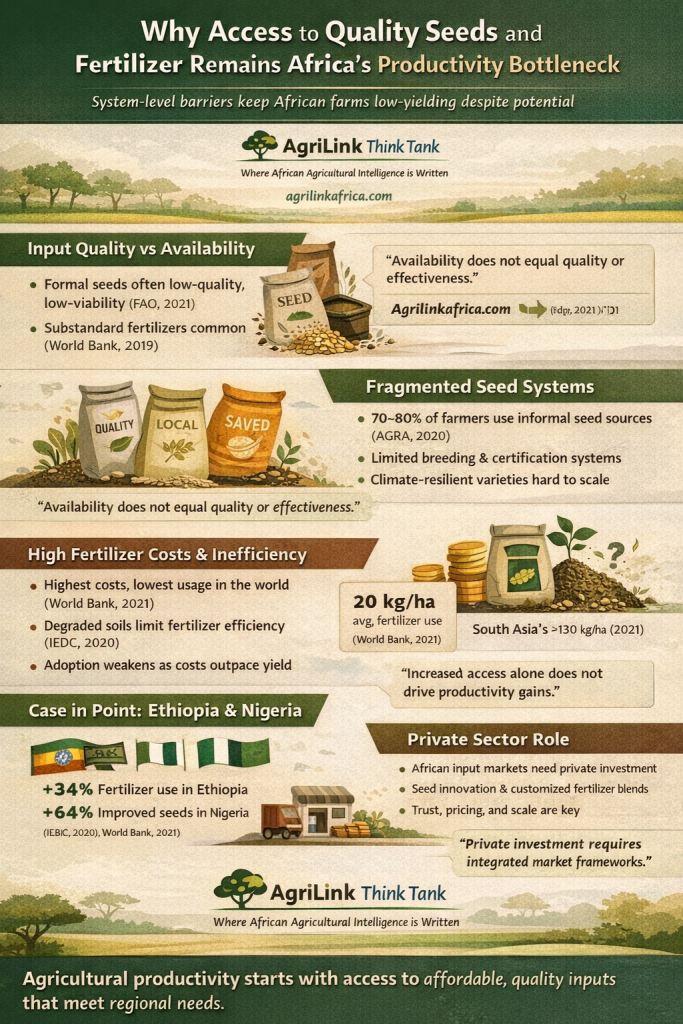
In many African markets, seeds and fertilizers are technically “available,” but availability does not equal quality or effectiveness.
The Food and Agriculture Organization shows that a large share of seeds circulating in informal markets are uncertified, genetically mixed, or low-viability varieties, leading to poor germination and low yield response FAO, 2021
Similarly, fertilizer markets suffer from quality dilution, improper formulation, and weak regulatory enforcement. The World Bank identifies substandard fertilizer quality as a major contributor to low productivity response rates in African farming systems World Bank, 2019
This creates a structural paradox:
- Inputs exist in markets
- Farmers buy them
- Yields remain low
- Trust declines
- Adoption weakens
- Informal systems expand
Productivity fails not because of absence — but because of systemic input failure.
Seed Systems in Africa
Africa’s seed systems remain highly fragmented between formal and informal channels. Over 70–80% of smallholder farmers still source seeds from informal systems, including saved seeds, local markets, and community exchanges AGRA, 2020
While informal systems provide accessibility, they limit:
- Genetic improvement
- Disease resistance
- Climate resilience
- Yield potential
- Standardization
The Alliance for a Green Revolution in Africa identifies weak seed certification systems and limited private seed sector participation as core constraints to productivity growth (AGRA, 2020).
In many countries, regulatory barriers, low private investment incentives, and weak breeding pipelines restrict the scaling of improved seed varieties.
Without functional seed systems, agricultural transformation cannot scale — because productivity starts with genetics.
Fertilizer Affordability and Efficiency
Fertilizer use in sub-Saharan Africa remains the lowest in the world, averaging less than 20 kg per hectare, compared to over 130 kg per hectare in South Asia World Bank, 2021
However, the problem is not only low usage — it is inefficient usage.
The International Fertilizer Development Center shows that fertilizer response rates in African soils are often low due to:
- Soil degradation
- Poor formulation matching
- Lack of soil testing
- Improper application methods
- Incompatible seed varieties IFDC, 2020
Affordability further constrains adoption. High transport costs, import dependency, and currency volatility make fertilizers structurally expensive in landlocked and low-infrastructure regions AfDB, 2018
This creates a cycle where:
- Farmers under-apply fertilizer
- Soil fertility declines
- Productivity stagnates
- Income falls
- Input adoption declines further
Low productivity becomes self-reinforcing.
Case Examples: Ethiopia and Nigeria
Ethiopia
Ethiopia has made significant investments in fertilizer distribution systems, yet challenges persist in input efficiency and system design.
The Ethiopian Agricultural Transformation Institute reports that despite rising fertilizer use, yield response remains inconsistent due to soil variability, limited customized blends, and weak extension integration ATI, 2021
State-led distribution has improved reach but constrained private sector innovation, reducing system adaptability and farmer choice.
Nigeria
Nigeria’s seed and fertilizer reforms highlight the role of market structure.
The Presidential Fertilizer Initiative improved fertilizer availability, but challenges in distribution efficiency, affordability, and soil-specific formulation remain Federal Government of Nigeria, 2020
Seed sector reform has expanded private participation, but quality control and certification enforcement remain weak World Bank, 2020
In both countries, availability increased — productivity gains remained limited, proving that access alone is not transformation.
The Role of the Private Sector
Private sector participation is essential for building scalable, efficient input systems.
The World Bank identifies private input markets as critical to:
- Seed innovation
- Distribution efficiency
- Price competition
- Service quality
- Farmer trust World Bank, 2020
However, private investment is constrained by:
- Regulatory uncertainty
- Low rural purchasing power
- Weak logistics infrastructure
- Fragmented demand
- Limited risk-sharing mechanisms
Without integrated market design, private capital avoids smallholder input markets.
Policy and Market Fixes
Solving Africa’s productivity bottleneck requires system reform, not isolated programs.
Functional Seed Systems
- Private seed sector development
- Certification enforcement
- Breeding pipeline investment
- Regional seed harmonization frameworks African Union, 2018
Efficient Fertilizer Markets
- Soil-specific fertilizer blends
- Soil testing infrastructure
- Local production capacity
- Distribution cost reduction (IFDC, 2020)
Market Integration
- Digital input marketplaces
- Aggregated demand platforms
- Smart subsidy targeting World Bank, 2021
Institutional Coordination
- Integrated extension systems
- Public-private delivery models
- Performance-based subsidy systems (FAO, 2021)
Africa’s productivity challenge is not rooted in farmer effort, land scarcity, or climate alone.
It is rooted in input system failure.
Without:
- Quality seed systems
- Efficient fertilizer markets
- Functional distribution networks
- Trustworthy quality regulation
- Integrated public-private models
productivity gains will remain incremental and fragile.
Agricultural transformation begins not at harvest, but at the input system level.
Until Africa builds input systems as infrastructure, productivity will remain structurally constrained — and food security will remain vulnerable.
AgriLink Think Tank
Where African Agricultural Intelligence Is Written

Abenezer Wondimagegn is the Founder & CEO of AgriLink Africa, a Research & Data Analyst, and Article Publisher. He specializes in Agriculture, Supply Chain, Logistics, Nutrition, E-commerce, and Business Investment. Through his work, he empowers farmers, strengthens food systems, and shares insights to drive innovation and sustainable growth in Ethiopia’s agricultural sector.

