
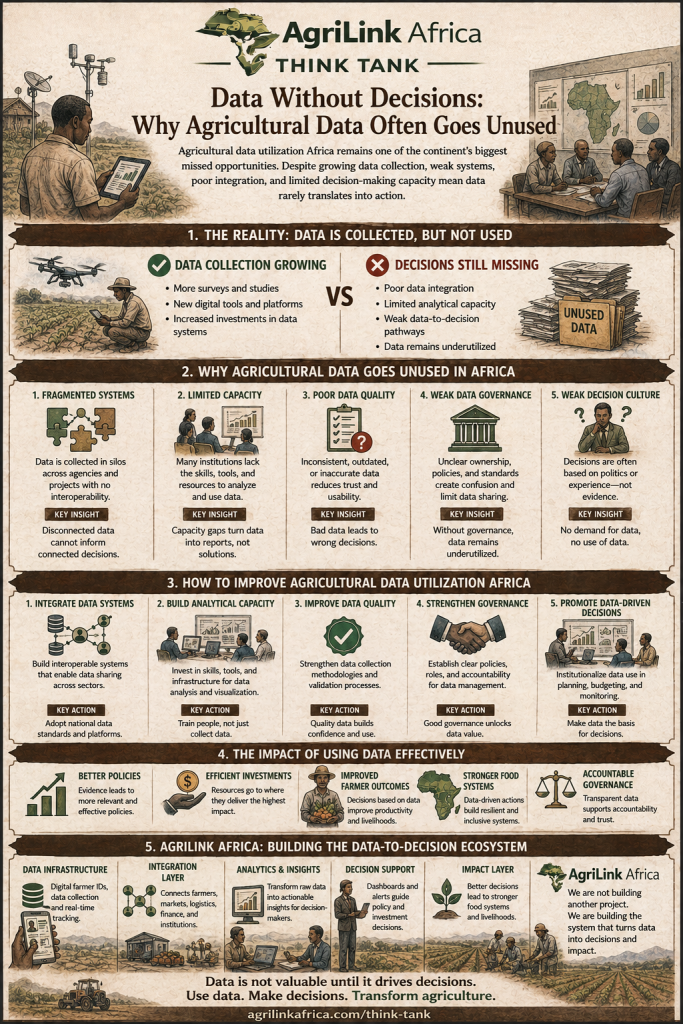
Agricultural data utilization Africa remains one of the continent’s most overlooked development challenges. Across Africa, governments, NGOs, agritech startups, research institutions, and donors continue investing heavily in digital agriculture systems, farmer registries, satellite monitoring, climate databases, and market information platforms. Yet despite this growing flood of information, agricultural decision-making often remains reactive, fragmented, and inefficient.
The issue is no longer data scarcity. Africa increasingly has access to agricultural data. The real challenge is converting data into coordinated decisions that improve productivity, financing, logistics, trade, food security, and resilience.
This disconnect has created a dangerous paradox: Africa is becoming data-rich but decision-poor.
According to the Food and Agriculture Organization (FAO, 2022), digital agriculture solutions are expanding rapidly across developing economies, but institutional integration and practical utilization remain weak. Similarly, the World Bank (2023) notes that agricultural transformation depends not merely on data collection, but on systems capable of translating information into operational coordination.
For Africa, this is not simply a technology problem. It is a systems governance problem.
The Agricultural Data Explosion Across Africa
Over the past decade, Africa has witnessed significant growth in agricultural data generation through:
- Mobile agriculture applications
- Satellite imaging systems
- Digital farmer registration platforms
- Climate monitoring tools
- Financial technology integrations
- Supply chain management systems
- Commodity exchange databases
- Remote sensing technologies
- Drone-based farm analytics
- IoT-enabled smart farming systems
Governments and development agencies have invested millions of dollars into agricultural digitization initiatives. Programs supported by organizations like the African Development Bank, FAO, and CGIAR continue promoting data-driven agriculture across the continent.
However, many of these systems operate independently.
Data exists in silos.
Ministries often cannot exchange information with one another. Financial institutions lack access to verified production intelligence. Logistics providers operate without synchronized market forecasting. Farmers remain disconnected from predictive insights that could improve planning.
The result is fragmented intelligence with limited operational value.
This mirrors broader structural issues discussed in AgriLink Think Tank’s analysis on Policy Alignment Failure: When Ministries Don’t Talk and Why Africa Needs Agricultural Operating Systems, Not More Projects.
Why Agricultural Data Often Goes Unused
1. Data Collection Is Prioritized Over Decision Architecture
Many agricultural programs focus heavily on collecting data but invest very little in designing decision systems.
This creates “data warehouses without action pathways.”
For example:
- Farmer databases may exist without financing integration
- Climate forecasts may not connect to crop insurance triggers
- Market price systems may not influence logistics planning
- Yield surveys may not shape national procurement decisions
The core failure lies in the absence of operational coordination mechanisms.
Data becomes a reporting tool instead of a governance tool.
According to the OECD Digital Agriculture Review (2022), many agricultural digitalization initiatives globally struggle because institutions fail to redesign operational workflows around data intelligence.
Africa faces this challenge at an even larger scale due to institutional fragmentation.
The Institutional Fragmentation Problem
Ministries, Agencies, and Platforms Operate Separately
One of the biggest barriers to agricultural data utilization Africa is institutional separation.
In many African countries:
- Agriculture ministries collect production data
- Trade ministries track imports and exports
- Meteorological agencies manage climate data
- Banks maintain financial risk records
- NGOs run separate farmer databases
- Agritech startups collect commercial transaction data
But these systems rarely communicate.
As a result:
- Governments struggle to forecast shortages accurately
- Banks cannot properly evaluate agricultural lending risks
- Policymakers respond slowly to supply disruptions
- Farmers receive fragmented recommendations
This weak coordination contributes directly to food inflation, post-harvest losses, and inefficient agricultural investments.
The World Economic Forum (2023) emphasizes that interoperable digital ecosystems are essential for modern agricultural transformation.
Without interoperability, data loses strategic value.
The Missing Layer: Agricultural Operating Systems
Information Without Execution Has Limited Value
Many policymakers assume more dashboards automatically improve agricultural performance.
This assumption is flawed.
Agriculture operates through physical systems:
- Farmers
- Roads
- Warehouses
- Markets
- Cold chains
- Financial flows
- Distribution networks
Data becomes valuable only when connected to operational response mechanisms.
For example:
Climate Warning Without Logistics Coordination
A drought alert is useful only if:
- Governments can coordinate response plans
- Banks can adjust lending strategies
- Input suppliers can redirect inventories
- Farmers receive actionable guidance
Otherwise, the data becomes informational rather than transformational.
Production Forecast Without Market Integration
Yield projections matter only if:
- Buyers adjust procurement
- Export systems prepare logistics
- Storage infrastructure expands accordingly
- Financing flows adapt early
Without execution systems, predictive intelligence remains underutilized.
Agricultural Data Utilization Africa and the Financing Gap
One major consequence of weak data utilization is financial exclusion.
Banks frequently avoid agriculture because:
- Risk visibility is weak
- Production tracking is unreliable
- Supply chain intelligence is fragmented
- Insurance verification is difficult
The International Finance Corporation (IFC, 2023) notes that digital financial ecosystems can significantly reduce agricultural lending risks when integrated with reliable production and transaction data.
However, disconnected systems prevent this integration from functioning effectively.
This is why many African financial institutions still perceive agriculture as “high risk,” despite rising digital investments.
The problem is not simply lack of data.
It is lack of usable, interoperable intelligence.
Key Reasons Agricultural Data Systems Fail in Africa
1. Lack of Interoperability
Platforms cannot exchange information efficiently.
2. Donor-Driven Fragmentation
Projects often create parallel systems without long-term integration strategies.
3. Weak Institutional Coordination
Government agencies operate independently.
4. Poor Last-Mile Connectivity
Farmers may not receive actionable outputs from collected data.
5. Limited Local Ownership
Many digital systems rely heavily on external technical structures.
6. Data Governance Gaps
Questions around ownership, privacy, standardization, and access remain unresolved.
7. Weak Commercial Integration
Data systems often fail to connect with banks, insurers, traders, and logistics providers.
What Africa Needs Instead
From Data Projects to Decision Ecosystems
Africa needs integrated agricultural intelligence ecosystems capable of supporting real-time coordination.
This requires:
1. Unified Agricultural Data Standards
Countries should establish national interoperability frameworks.
2. Cross-Ministerial Coordination Systems
Agriculture, trade, finance, transport, and climate agencies must share operational intelligence.
3. Real-Time Agricultural Dashboards
Not just for monitoring — but for triggering coordinated responses.
4. Public-Private Agricultural Intelligence Partnerships
Banks, agritech firms, logistics providers, and governments should collaborate within shared frameworks.
5. Localized Agricultural Operating Systems
Africa needs homegrown systems adapted to regional realities rather than imported digital templates.
The Strategic Importance of Agricultural Intelligence Infrastructure
Agricultural intelligence infrastructure will likely become one of Africa’s most important strategic assets over the next decade.
Countries capable of integrating:
- Production systems
- Logistics
- Market intelligence
- Climate forecasting
- Financial systems
will achieve stronger:
- Food security
- Export competitiveness
- Rural industrialization
- Agricultural financing
- Crisis resilience
The United Nations Economic Commission for Africa (UNECA) increasingly highlights digital infrastructure as foundational to economic transformation across the continent.
Agriculture cannot modernize through isolated applications alone.
It requires system-wide intelligence architecture.
Conclusion: Africa’s Future Depends on Decision Systems, Not Just Data
Agricultural data utilization Africa is ultimately about transforming information into coordinated action.
The continent does not primarily suffer from lack of agricultural data anymore. Instead, it suffers from fragmented systems incapable of converting intelligence into synchronized execution.
Africa’s next agricultural transformation phase will not be driven simply by collecting more information.
It will be driven by:
- Interoperable systems
- Institutional coordination
- Agricultural operating systems
- Predictive intelligence
- Integrated logistics
- Financial synchronization
- Decision-centered governance
This is precisely why AgriLink Africa advocates building integrated agricultural ecosystems instead of isolated projects.
The future of African agriculture belongs not to those who collect the most data — but to those who build the strongest decision systems.
Frequently Asked Questions (FAQs)
What is agricultural data utilization Africa?
Agricultural data utilization Africa refers to how agricultural information — including climate, production, market, and farmer data — is transformed into practical decisions that improve farming systems, financing, logistics, and policymaking.
Why does agricultural data often go unused in Africa?
Agricultural data often goes unused because systems are fragmented, institutions operate separately, interoperability is weak, and many platforms focus on data collection rather than operational coordination.
How can Africa improve agricultural data utilization?
Africa can improve agricultural data utilization by developing integrated agricultural operating systems, establishing interoperability standards, strengthening institutional coordination, and connecting data systems with real operational workflows.

Abenezer Wondimagegn is the Founder & CEO of AgriLink Africa, a Research & Data Analyst, and Article Publisher. He specializes in Agriculture, Supply Chain, Logistics, Nutrition, E-commerce, and Business Investment. Through his work, he empowers farmers, strengthens food systems, and shares insights to drive innovation and sustainable growth in Ethiopia’s agricultural sector.

