
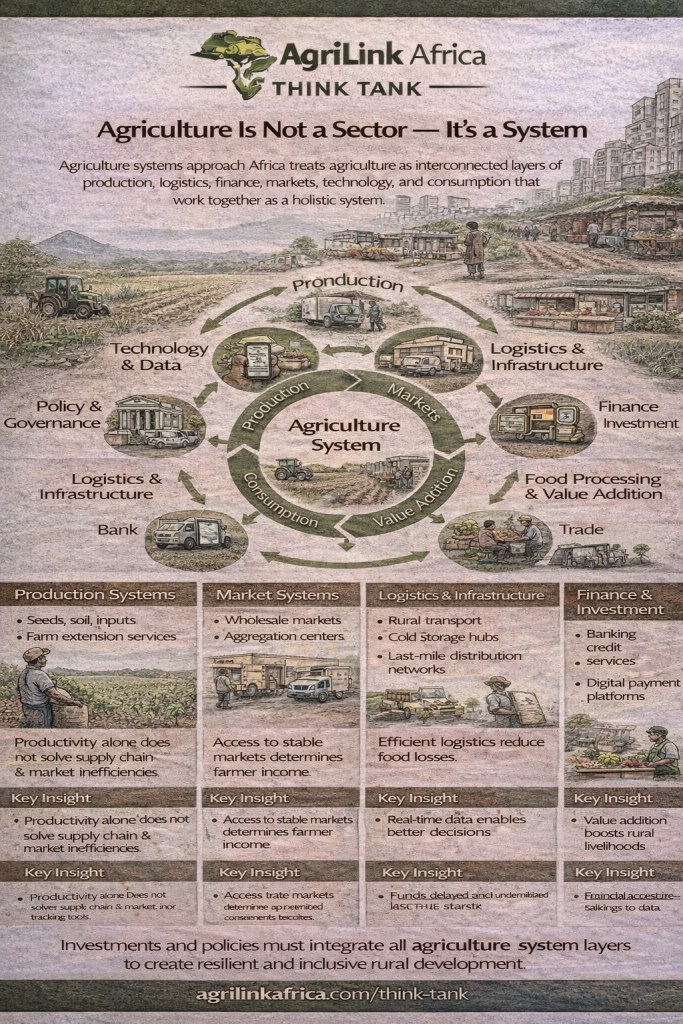
Agriculture system approach Africa is becoming one of the most important policy ideas for the continent’s food future. For decades, agriculture has often been treated as a single economic sector focused primarily on farming activities. Governments develop agricultural policies, ministries distribute inputs, and development programs support farmers.
Agriculture does not operate in isolation. It is connected to logistics, finance, infrastructure, markets, technology, nutrition systems, climate resilience, and trade. When policymakers focus only on production, they ignore the broader ecosystem that determines whether food actually reaches consumers and whether farmers earn sustainable incomes.
Understanding these connections requires a broader perspective on food systems across the continent. For a deeper structural overview, see our pillar research on Food Systems Transformation.
Yet across Africa, this narrow sector-based thinking has repeatedly produced limited results.
Agriculture does not operate in isolation. It is connected to logistics, finance, infrastructure, markets, technology, nutrition systems, climate resilience, and trade. When policymakers focus only on production, they ignore the broader ecosystem that determines whether food actually reaches consumers and whether farmers earn sustainable incomes.
A true agriculture system approach Africa recognizes that food systems function as interconnected networks. Productivity improvements alone cannot solve food insecurity unless the entire system—from soil to market—is addressed.
This article explains why agriculture must be understood as a system rather than a sector, and why adopting a systems-based policy framework is essential for Africa’s agricultural transformation.
Why Sector-Based Agricultural Policy Often Fails
Many African agricultural strategies historically focus on increasing farm production through inputs such as seeds, fertilizers, and extension services. While these interventions are important, they often fail to deliver lasting transformation.
The reason is simple: production is only one component of a larger agricultural system.
Consider what happens when production increases without supporting systems.
Common policy gaps include:
- Weak rural transportation infrastructure
- Lack of cold chain logistics
- Limited market access
- Poor price discovery mechanisms
- Limited storage capacity
- Fragmented value chains
According to the Food and Agriculture Organization, nearly 30–40% of food produced in Sub-Saharan Africa is lost before reaching consumers due to inefficiencies in storage, transport, and market systems (FAO, 2021).
When policymakers focus only on farm-level interventions, these system failures remain unresolved.
This is why many agricultural development programs achieve temporary productivity gains but fail to produce sustainable rural prosperity.
For further analysis of policy breakdowns between strategy and implementation, see:
Understanding the Agriculture System Approach Africa
The agriculture system approach Africa treats agriculture as a network of interconnected components rather than a standalone sector.
These components include:
- Production Systems
- Market Systems
- Logistics and Infrastructure
- Finance and Investment
- Technology and Data
- Food Processing and Value Addition
- Nutrition and Consumption
- Policy and Governance
When these components function together, agriculture becomes a dynamic economic engine.
When they operate separately, the system breaks down.
The Five Core Layers of the Agricultural System
1. Farm Production Layer
This is the traditional focus of agricultural policy.
It includes:
- Seeds and crop varieties
- Soil management
- Fertilizers and inputs
- Irrigation
- Extension services
Improving farm productivity is essential, but productivity without markets leads to oversupply and price collapse.
2. Market Access Layer
Farmers need reliable pathways to sell their produce.
This includes:
- Wholesale markets
- Digital marketplaces
- Contract farming systems
- Aggregation centers
- Market information systems
The World Bank highlights that improving market access can significantly increase farmer income by reducing price asymmetry and intermediary inefficiencies (World Bank, 2020).
Without functioning markets, increased production does not translate into prosperity.
3. Logistics and Distribution Layer
Agriculture is highly dependent on movement systems.
Key components include:
- Rural road infrastructure
- Cold chain logistics
- Storage facilities
- Transportation networks
- Last-mile delivery systems
In many African cities, food travels through informal and fragmented logistics networks, increasing losses and prices.
Modern agricultural systems integrate supply chain infrastructure into agricultural development strategies.
4. Value Addition and Processing Layer
Raw agricultural commodities generate limited income.
Economic transformation requires value addition through:
- Food processing
- Packaging
- Branding
- Agro-industrial manufacturing
Countries that invest in agro-processing capture more economic value within domestic economies.
For example, cocoa-producing countries often export raw beans rather than processed chocolate, losing substantial value.
The African Development Bank emphasizes agro-industrial development as a central pillar of Africa’s agricultural transformation (AfDB, 2019).
5. Consumption and Nutrition Layer
Agriculture ultimately exists to support food security and nutrition outcomes.
Policies must therefore consider:
- Urban food demand
- Nutrition diversity
- Food affordability
- Consumer access
- Dietary transitions
Agricultural policies that ignore consumption patterns often produce crops that do not align with nutrition needs or market demand.
The Food System Perspective
Modern agricultural development increasingly adopts a food systems perspective.
A food system includes:
- Production
- Processing
- Distribution
- Retail
- Consumption
- Waste management
This framework recognizes that agriculture connects directly to:
- Public health
- Climate resilience
- Economic development
- Urbanization
- Trade systems
The United Nations Food Systems Summit highlighted the need to transform global food systems to achieve sustainable development goals (UN, 2021).
Africa must adopt this systemic approach to address its unique development challenges.
Example: Urban Food Systems in African Cities
Urbanization is rapidly transforming African food systems.
Cities such as Lagos, Nairobi, and Addis Ababa depend on complex rural-urban supply networks.
Urban food systems require:
- Efficient wholesale markets
- Cold storage hubs
- Digital distribution platforms
- Transport coordination
- Retail networks
Without system coordination, urban food supply chains become fragmented, inefficient, and expensive.
For example, the rise of digital agricultural marketplaces is helping connect farmers directly to urban buyers.
Related analysis:
Why Africa Needs an Agriculture System Approach
The agriculture system approach Africa offers several strategic advantages.
1. It Aligns Policies Across Ministries
Agriculture interacts with multiple sectors:
- Transport
- Trade
- Industry
- Finance
- Health
A systems approach encourages cross-ministerial coordination.
2. It Reduces Post-Harvest Losses
When logistics systems improve:
- Food waste declines
- Supply chains stabilize
- Farmer income increases
For deeper insights on structural inefficiencies, see:
3. It Strengthens Rural Economies
Agricultural systems generate employment across multiple segments:
- Logistics
- Processing
- Retail
- Technology
- Services
Agriculture therefore becomes a broader rural economic ecosystem.
4. It Supports Data-Driven Agriculture
Digital systems allow better coordination of agricultural networks.
Examples include:
- farm geolocation mapping
- supply chain tracking
- digital marketplaces
- logistics optimization
- climate monitoring
See related research:
Policy Implications for Governments
To implement an agriculture system approach Africa, governments should shift policy frameworks in several ways.
Key policy priorities include:
- Integrating food systems into national development strategies
- Investing in logistics infrastructure
- rural roads
- cold chain systems
- storage hubs
- Supporting digital agricultural platforms
- Developing agro-processing industries
- Improving rural financial access
- Encouraging private-sector participation
These reforms require coordinated institutional planning, not isolated agricultural projects.
For example:
The Role of Digital Platforms in Agricultural Systems
Digital technologies are emerging as system integrators within agricultural ecosystems.
Platforms can connect:
- Farmers
- Buyers
- Logistics providers
- Financial institutions
- Agricultural advisors
Examples of digital system functions include:
- GPS-based farm mapping
- digital marketplaces
- demand forecasting
- supply chain coordination
- price transparency
These tools help transform fragmented agricultural systems into coordinated food networks.
Conclusion
The agriculture system approach Africa represents a fundamental shift in how agricultural development is understood and implemented.
Agriculture is not simply about farming. It is about systems of production, distribution, markets, infrastructure, technology, and nutrition.
Policies that focus only on increasing yields overlook the broader structural realities that determine whether agriculture can drive economic transformation.
Africa’s agricultural future therefore depends on integrating farming into a larger economic system.
When agriculture is treated as a system rather than a sector, it becomes capable of delivering:
- rural prosperity
- food security
- industrial growth
- sustainable development
The challenge ahead for policymakers is not merely to improve farms—but to design and coordinate the entire agricultural system.
Frequently Asked Questions (FAQs)
What is the agriculture system approach Africa?
The agriculture system approach Africa refers to treating agriculture as a connected system that includes production, logistics, markets, finance, technology, and consumption rather than focusing only on farming activities.
Why is the agriculture system approach Africa important?
The agriculture system approach Africa helps address structural problems such as post-harvest losses, weak market access, and inefficient supply chains by improving coordination across the entire food system.
How can governments implement the agriculture system approach Africa?
Governments can implement the agriculture system approach Africa by investing in logistics infrastructure, supporting digital agricultural platforms, strengthening agro-processing industries, and coordinating policies across sectors such as transport, trade, and finance.
AgriLink Africa Think Tank
Advancing research and policy insights for Africa’s agricultural transformation.

Abenezer Wondimagegn is the Founder & CEO of AgriLink Africa, a Research & Data Analyst, and Article Publisher. He specializes in Agriculture, Supply Chain, Logistics, Nutrition, E-commerce, and Business Investment. Through his work, he empowers farmers, strengthens food systems, and shares insights to drive innovation and sustainable growth in Ethiopia’s agricultural sector.

