
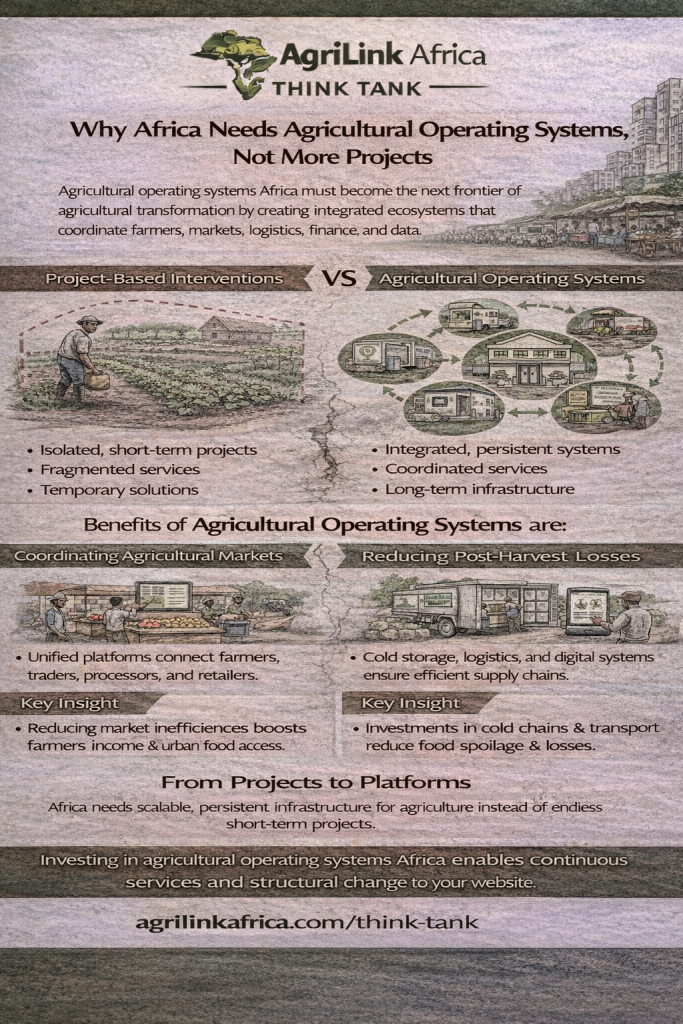
Agricultural operating systems Africa must become the next frontier of agricultural transformation across the continent. For decades, development programs, donor-funded initiatives, and government interventions have attempted to improve agricultural productivity through thousands of isolated projects. While many of these programs have delivered short-term benefits, their long-term impact has often remained limited.
The fundamental challenge is not simply a lack of investment or innovation. The deeper issue is structural: Africa’s agricultural development approach is still largely project-driven rather than system-driven.
Projects typically operate within narrow timelines, limited geographic areas, and specific funding cycles. When funding ends, the initiative often disappears, leaving little structural change behind. In contrast, agricultural operating systems Africa aim to create persistent infrastructure that enables farmers, markets, logistics providers, and institutions to interact within a coordinated ecosystem.
This distinction between projects and systems is becoming one of the most important strategic questions for policymakers, investors, and development institutions seeking sustainable agricultural transformation.
The Limits of Project-Based Agricultural Development
Over the past three decades, Africa has hosted thousands of agricultural development projects designed to address issues such as productivity, food security, rural livelihoods, and market access.
These initiatives often include:
- Input subsidy programs
- Farmer training initiatives
- Irrigation pilot projects
- Digital agriculture platforms
- Value chain development programs
Many of these interventions produce meaningful short-term outcomes. However, their impact frequently fades after the project cycle ends.
Several structural factors explain this pattern.
Fragmentation of Agricultural Interventions
Most projects operate independently, focusing on specific value chains or geographic areas. As a result, agricultural systems remain fragmented.
Farmers may gain access to improved seeds through one project, training through another, and market linkages through a third—yet these services are rarely integrated into a unified ecosystem.
Limited Scalability
Pilot projects often demonstrate promising results in small areas but struggle to scale across national agricultural systems.
Scaling requires infrastructure, institutional coordination, and digital platforms that extend beyond individual project boundaries.
Short-Term Funding Cycles
Many agricultural initiatives operate within three- to five-year funding cycles. Structural transformation, however, requires long-term system development that extends beyond project timelines.
Understanding Agricultural Operating Systems
The concept of agricultural operating systems Africa draws inspiration from digital platforms and operating systems used in technology ecosystems.
Just as a computer operating system provides the infrastructure that allows applications to function, an agricultural operating system provides the structural framework that enables different actors in the agricultural economy to interact efficiently.
An agricultural operating system integrates multiple components of the food economy into a coordinated system.
These components may include:
- Farmer registration and data systems
- Digital marketplaces for agricultural products
- Logistics coordination platforms
- Cold chain and storage infrastructure
- Financial services for farmers and agribusinesses
- Agronomic advisory systems
- Traceability and compliance systems
Rather than functioning as isolated projects, these components operate together as a persistent agricultural infrastructure layer.
Why Agricultural Operating Systems Matter for Africa
Africa’s agricultural sector faces structural challenges that cannot be solved through isolated interventions.
According to the Food and Agriculture Organization, food losses in sub-Saharan Africa remain significant due to weak storage, logistics, and market systems (FAO, 2021).
Similarly, the African Development Bank highlights the importance of building integrated agricultural value chains rather than fragmented production systems (AfDB, 2019).
These challenges illustrate why agricultural operating systems Africa are becoming increasingly important.
1. Coordinating Agricultural Markets
Operating systems enable farmers, traders, processors, and retailers to interact within a unified marketplace.
Digital platforms can improve price transparency and reduce information asymmetry between rural producers and urban markets.
2. Reducing Post-Harvest Losses
Integrated logistics systems—combined with cold storage infrastructure—can significantly reduce post-harvest losses.
Operating systems can coordinate transportation, storage availability, and distribution routes.
3. Supporting Data-Driven Agriculture
Agricultural operating systems generate valuable datasets that can support better decision-making.
These may include:
- Weather and climate data
- Soil and crop information
- Market price data
- Production forecasts
Access to reliable data improves planning for both farmers and policymakers.
From Projects to Platforms
A key characteristic of agricultural operating systems Africa is the shift from isolated initiatives toward platform-based agricultural infrastructure.
Instead of launching new projects for every agricultural challenge, policymakers and institutions can build platforms that allow multiple services to operate within a shared ecosystem.
Examples of services that can run on agricultural operating systems include:
- Digital extension services
- Farmer financing programs
- Input supply networks
- Market aggregation services
- Export traceability systems
This platform model enables continuous innovation without rebuilding infrastructure for every new initiative.
Policy Implications for African Governments
Building agricultural operating systems Africa requires a new approach to agricultural policy.
Governments must move beyond project management toward system architecture.
Key policy priorities may include:
1. National Farmer Registration Systems
Reliable farmer databases are foundational for agricultural operating systems.
These systems allow governments and private sector actors to deliver services efficiently.
2. Digital Market Infrastructure
Governments can support digital platforms that connect farmers directly with markets.
Such platforms reduce transaction costs and improve price transparency.
3. Integrated Logistics Infrastructure
Investment in rural roads, aggregation centers, and cold chain infrastructure remains essential.
Operating systems can coordinate these assets more efficiently.
4. Public–Private Partnerships
Agricultural operating systems are unlikely to succeed without strong collaboration between governments, technology companies, agribusinesses, and farmer organizations.
The Role of Digital Agriculture
Digital agriculture technologies are accelerating the emergence of agricultural operating systems Africa.
Mobile technology adoption across the continent provides new opportunities for building integrated agricultural platforms.
Digital tools can support:
- Farmer onboarding and registration
- Mobile payments and financial services
- Market price transparency
- Supply chain traceability
- Agricultural advisory services
These technologies allow agricultural operating systems to operate at scale.
The World Bank has highlighted digital agriculture as a key driver of agricultural modernization in developing economies (World Bank, 2022).
Building Agricultural Operating Systems in Africa
Several emerging initiatives across Africa are beginning to adopt operating system–like approaches to agricultural development.
These initiatives often combine multiple components:
- Digital marketplaces
- Farmer data systems
- Logistics coordination
- Cold chain infrastructure
- Market analytics
One example is the growing interest in integrated agri-commerce ecosystems that connect production with distribution and retail markets.
These ecosystem models reflect a broader shift toward systems thinking in agriculture.
For deeper exploration of systems thinking in African agriculture, see:
- Agriculture Is Not a Sector — It’s a System
- Why Agricultural Policies Collapse Between Capital Cities and Villages
Alignment with AgriLink Africa Think Tank Pillars
The concept of agricultural operating systems Africa aligns closely with several key research pillars explored by the AgriLink Africa Think Tank.
These include:
- African Agricultural Systems
- Food Systems Transformation
- Agri-Commerce Ecosystems
- Digital Agriculture in Africa
These thematic areas emphasize the importance of moving beyond fragmented interventions toward integrated agricultural systems.
The Future of Agricultural Transformation
Africa possesses immense agricultural potential. The continent holds approximately 60 percent of the world’s uncultivated arable land suitable for agriculture (World Bank, 2020).
However, unlocking this potential requires more than increasing production.
It requires building agricultural infrastructure that coordinates markets, logistics, information, and services across the food system.
In other words, Africa does not simply need more agricultural projects.
Africa needs agricultural operating systems.
These systems can transform agriculture from a fragmented sector into a coordinated economic engine capable of supporting food security, rural prosperity, and sustainable development.
Frequently Asked Questions
What are agricultural operating systems in Africa?
Agricultural operating systems Africa refer to integrated platforms that connect farmers, markets, logistics, financial services, and agricultural data within a unified system. These systems enable coordinated agricultural ecosystems rather than isolated development projects.
Why does Africa need agricultural operating systems instead of projects?
Projects often operate within limited timelines and geographic areas. Agricultural operating systems Africa provide long-term infrastructure that supports continuous services such as digital markets, logistics coordination, and agricultural data systems.
How can agricultural operating systems transform African agriculture?
By integrating production, logistics, markets, and digital infrastructure, agricultural operating systems Africa can reduce post-harvest losses, improve market access, support data-driven agriculture, and enable scalable agricultural innovation.
AgriLink Africa Think Tank continues to explore how integrated systems, digital infrastructure, and agri-commerce ecosystems can shape the future of African agriculture.

Abenezer Wondimagegn is the Founder & CEO of AgriLink Africa, a Research & Data Analyst, and Article Publisher. He specializes in Agriculture, Supply Chain, Logistics, Nutrition, E-commerce, and Business Investment. Through his work, he empowers farmers, strengthens food systems, and shares insights to drive innovation and sustainable growth in Ethiopia’s agricultural sector.

