
Policy alignment Africa is one of the most critical yet overlooked challenges undermining agricultural transformation across the continent. Despite billions invested in agriculture, infrastructure, trade, and rural development, outcomes remain fragmented because ministries often operate in isolation rather than as a coordinated system.
In many African countries, agriculture ministries design production strategies, while trade ministries pursue export policies, and transport ministries build infrastructure—all without alignment. This disconnect results in inefficiencies, duplication, and policy contradictions that directly affect farmers, agribusinesses, and national food systems.
This article explores why policy alignment Africa continues to fail, the consequences of siloed governance, and how countries can transition toward integrated, system-based policy frameworks.
Understanding Policy Alignment in Africa’s Agricultural Systems
What Is Policy Alignment?
Policy alignment refers to the coordination and coherence of policies across ministries, agencies, and sectors to achieve shared national goals. In agriculture, this means synchronizing:
- Production policies (Ministry of Agriculture)
- Trade and export regulations (Ministry of Trade)
- Infrastructure development (Ministry of Transport)
- Environmental sustainability (Ministry of Environment)
- Financial access (Ministry of Finance)
When alignment is absent, policies may conflict, cancel each other out, or fail to scale.
Why Policy Alignment Africa Matters
Agriculture is inherently a multi-sector system, not a standalone sector. Without alignment:
- Farmers cannot access markets efficiently
- Supply chains become fragmented
- Investments yield low returns
- National food security strategies fail
As highlighted in Why Africa Needs Agricultural Operating Systems, Not More Projects, transformation requires systems thinking—not isolated interventions.
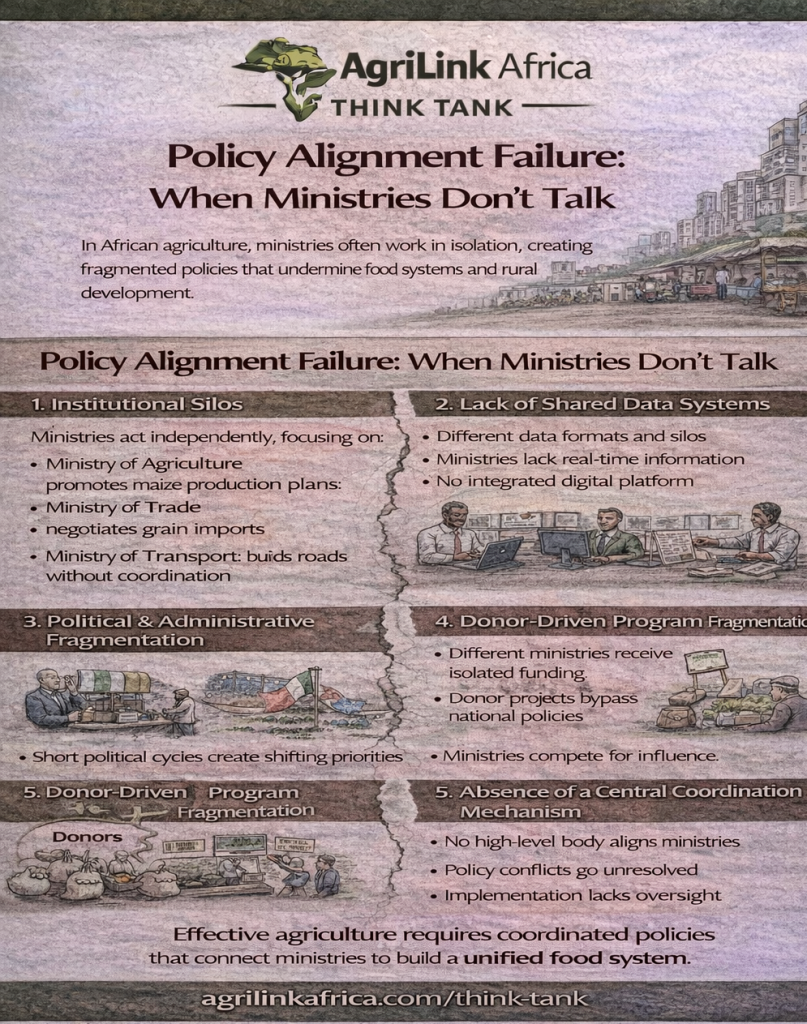
The Root Causes of Policy Alignment Failure
1. Institutional Silos
Ministries operate independently, each with its own:
- Budget
- KPIs
- Reporting structures
This creates competition rather than collaboration.
Example:
A Ministry of Agriculture promotes maize production, while the Ministry of Trade imports cheaper maize, undermining local farmers.
Data fragmentation prevents coordination. Ministries often:
- Use different data formats
- Do not share real-time information
- Lack integrated platforms
According to World Bank, 2022, data-driven policy coordination is essential for effective agricultural transformation.
3. Political and Administrative Fragmentation
Frequent changes in leadership disrupt continuity. Policies are:
- Politically driven rather than system-driven
- Short-term rather than strategic
- Often duplicated across ministries
4. Donor-Driven Program Fragmentation
Development partners often fund projects within specific ministries, reinforcing silos.
As discussed in Why Agricultural Policies Collapse Between Capital Cities and Villages, externally funded programs often lack integration into national systems.
5. Absence of a Central Coordination Mechanism
Few countries have a strong central body responsible for cross-ministerial alignment.
Without this:
- Policies remain disconnected
- Implementation becomes inconsistent
- Accountability is unclear
The Consequences of Poor Policy Alignment Africa
1. Contradictory Policies
Policies often work against each other:
- Export bans vs. production incentives
- Subsidies vs. market liberalization
- Infrastructure plans vs. actual production zones
2. Inefficient Resource Allocation
Governments and donors invest heavily, yet:
- Projects overlap
- Resources are duplicated
- Impact remains limited
3. Weak Agricultural Value Chains
Disconnected policies lead to:
- Post-harvest losses
- Poor logistics
- Limited market access
According to FAO, 2021, weak coordination significantly contributes to supply chain inefficiencies in Africa.
4. Low Farmer Trust in Government Systems
Farmers experience policy inconsistency as:
- Price volatility
- Market uncertainty
- Lack of reliable support systems
Case Example: Policy Misalignment in Practice
Consider a typical scenario:
- The government promotes tomato production
- Farmers increase output
- No cold storage or logistics planning is aligned
- Market access is not coordinated
- Prices collapse due to oversupply
This is not a production failure—it is a policy alignment failure.
Policy Alignment Africa and the System Gap
Projects vs Systems
Africa has thousands of successful pilot projects. However, scaling fails because:
- Projects operate within single ministries
- Systems require cross-ministerial integration
As highlighted in AgriLink Africa’s systems framework, transformation requires Agricultural Operating Systems (AgOS) that connect all actors.
Pathways to Strengthening Policy Alignment
1. Establish Central Coordination Units
Governments should create high-level coordination bodies:
- Located in the Prime Minister’s or President’s office
- Responsible for cross-ministerial alignment
- Equipped with decision-making authority
2. Develop Integrated Policy Frameworks
Instead of isolated policies, countries should adopt:
- National agricultural system frameworks
- Cross-sector strategies
- Unified implementation roadmaps
3. Implement Shared Digital Platforms
Digital systems can enable alignment through:
- Real-time data sharing
- Integrated farmer registries
- Coordinated logistics planning
This aligns with AgriLink Africa’s approach to building a unified digital agro-commerce ecosystem.
4. Align Budgeting and Incentives
Policy alignment Africa requires financial alignment:
- Joint budgeting across ministries
- Shared performance indicators
- Incentives for collaboration
5. Strengthen Decentralized Coordination
Alignment must extend beyond capital cities:
- Regional governments must be integrated
- Local implementation must reflect national strategy
As discussed in Bridging Policy Gaps Between Cities and Villages, local-level execution is where policies succeed or fail.
6. Integrate Private Sector and Farmer Systems
Policy alignment must include:
- Agribusinesses
- Cooperatives
- Digital platforms
This ensures policies reflect real market conditions.
The Role of Agricultural Operating Systems
Moving Beyond Ministries
Agricultural Operating Systems (AgOS) provide a framework where:
- Policies are integrated into digital platforms
- Data flows across sectors
- Decision-making becomes coordinated
Key Features of an Aligned System
- Unified farmer database
- Integrated logistics and market systems
- Policy dashboards for decision-makers
- Real-time monitoring and feedback loops
A Strategic Shift: From Governance to Systems Leadership
Policy alignment Africa requires a shift from:
| Traditional Approach | Systems Approach |
|---|---|
| Ministry-based | System-based |
| Project-driven | Platform-driven |
| Fragmented data | Integrated data |
| Short-term policies | Long-term frameworks |
Conclusion: Alignment Is the Missing Link
Africa does not lack policies, funding, or expertise. What it lacks is alignment.
When ministries do not talk:
- Farmers pay the price
- Systems fail to scale
- Investments underperform
The future of African agriculture depends on moving from fragmented governance to integrated systems. Policy alignment Africa is not a technical issue—it is a strategic imperative.
FAQs on Policy Alignment Africa
1. What is policy alignment Africa?
Policy alignment Africa refers to the coordination of policies across different ministries and sectors to ensure coherent agricultural and economic development strategies.
2. Why does policy alignment Africa fail?
Policy alignment Africa fails due to institutional silos, lack of shared data systems, political fragmentation, and absence of central coordination mechanisms.
3. How can policy alignment Africa be improved?
Policy alignment Africa can be improved through centralized coordination units, integrated digital systems, aligned budgeting, and system-based policy frameworks.

Abenezer Wondimagegn is the Founder & CEO of AgriLink Africa, a Research & Data Analyst, and Article Publisher. He specializes in Agriculture, Supply Chain, Logistics, Nutrition, E-commerce, and Business Investment. Through his work, he empowers farmers, strengthens food systems, and shares insights to drive innovation and sustainable growth in Ethiopia’s agricultural sector.

