
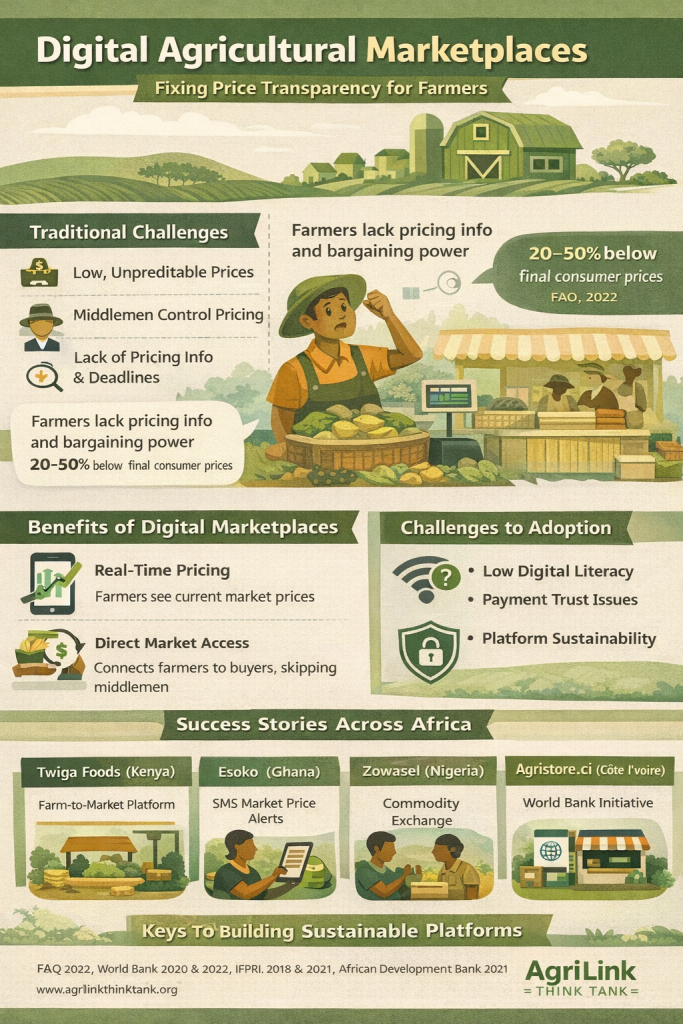
Price transparency is one of the most persistent structural weaknesses in African agricultural markets. Although smallholder farmers produce most of the continent’s food, they often sell without knowing prevailing market prices, buyer demand, or quality premiums. This information asymmetry weakens farmers’ bargaining power and allows intermediaries to capture a disproportionate share of value.
Digital agricultural marketplaces—platforms that connect farmers and buyers through mobile and web technologies—are increasingly positioned as a solution. When properly designed, these platforms can improve price discovery, reduce transaction costs, and support inclusive market participation.
Traditional Market Failures in Agricultural Pricing
Agricultural markets across Africa are typically fragmented, informal, and opaque. Farmers commonly sell at farm gates or village markets, where prices are negotiated individually and influenced by urgency, perishability, and lack of alternatives.
The Food and Agriculture Organization (FAO, 2022) reports that smallholder farmers in Sub-Saharan Africa often receive 20–50% less than final consumer prices, primarily due to weak market information systems and long chains of intermediaries
FAO, 2022
Similarly, the World Bank (2019) highlights that poor price transparency discourages competition, limits private investment, and locks farmers into low-value market participation
World Bank, 2019
These failures are particularly severe for perishable commodities such as fruits, vegetables, dairy, and fish, where farmers face pressure to sell quickly to avoid spoilage.
Digital Pricing Models and Market Transparency
Digital agricultural marketplaces address these failures by digitizing price discovery and transactions. Common pricing models include real-time spot pricing, contract-based pricing, auction systems, and reference price dissemination via SMS or mobile applications.
A study published in the Information Systems Journal (2020) found that access to digital price information increased farm-gate prices by 10–25%, depending on crop type and regional context
(Information Systems Journal, 2020
By publishing prices openly and standardizing grades, digital platforms reduce information asymmetry and create verifiable transaction records. These data trails can later support access to finance, insurance, and evidence-based policymaking.
Trust and Adoption Challenges
Despite their potential, adoption of digital marketplaces remains uneven. Trust is the most critical barrier.
The International Food Policy Research Institute (IFPRI, 2021) notes that many farmers hesitate to use digital platforms due to concerns over payment delays, fraud, and lack of dispute resolution mechanisms IFPRI, 2021
Digital literacy gaps and unreliable connectivity further limit adoption, especially in remote rural areas. Buyers also require assurances around quality consistency, delivery reliability, and volume aggregation—capabilities that platforms must actively manage.
Successful marketplaces therefore combine digital tools with offline support systems, including field agents, training programs, and logistics coordination.
Case Examples from Africa
In Kenya, Twiga Foods connects smallholder farmers directly to urban retailers, offering transparent pricing and predictable demand. The World Bank (2020) documents that the model reduced price volatility for farmers while improving supply reliability for vendors World Bank, 2020
In Ghana, Esoko provides SMS-based price alerts and digital market listings. Research by IFPRI (2018) shows that farmers using Esoko services achieved better negotiated prices and improved market participation IFPRI, 2018
Nigeria’s Zowasel operates a digital commodity exchange model focused on structured contracts and warehouse receipt systems, supporting transparent trade and price discovery
African Development Bank, 2021
These examples demonstrate that digital marketplaces are most effective when integrated with logistics, finance, and institutional trust mechanisms.
Sustainability of Digital Marketplace Platforms
Long-term sustainability remains a challenge for many digital agricultural marketplaces. According to the World Bank (2022), platforms relying solely on transaction commissions often struggle due to low volumes and thin margins World Bank, 2022
More resilient platforms diversify revenue streams by offering bundled services such as logistics, input supply, embedded finance, and data analytics. Public-private partnerships also play a critical role by supporting connectivity, data access, and regulatory recognition of digital contracts.
Digital agricultural marketplaces offer a credible pathway to fixing price transparency failures that have constrained African farmers for decades. Evidence shows that access to reliable price information improves incomes, strengthens negotiation power, and encourages productivity.
However, technology alone is not enough. Trust, infrastructure, policy support, and sustainable business models ultimately determine whether digital marketplaces scale successfully. For African food systems to benefit fully, digital market platforms must be embedded within broader agricultural and economic development strategies.

Abenezer Wondimagegn is the Founder & CEO of AgriLink Africa, a Research & Data Analyst, and Article Publisher. He specializes in Agriculture, Supply Chain, Logistics, Nutrition, E-commerce, and Business Investment. Through his work, he empowers farmers, strengthens food systems, and shares insights to drive innovation and sustainable growth in Ethiopia’s agricultural sector.

