
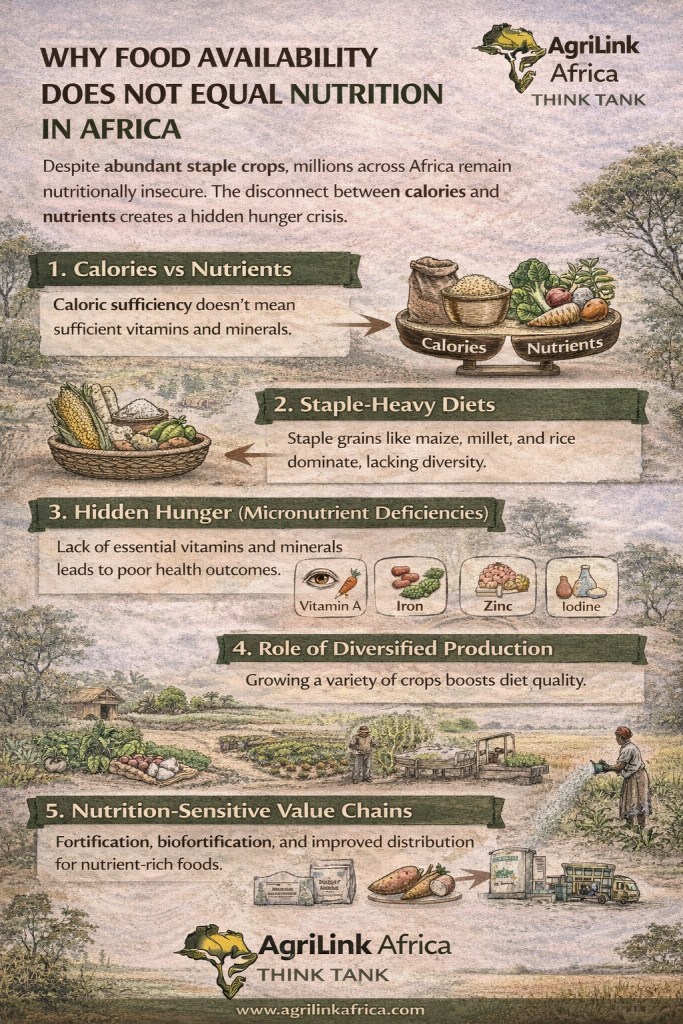
Food availability and nutrition in Africa are often treated as the same problem, yet millions remain malnourished despite sufficient calorie supply
Food security in Africa has historically been understood as a problem of food availability—producing enough calories to feed a rapidly growing population. But production statistics alone obscure a deeper crisis: millions of Africans remain nutritionally insecure despite adequate food supply. This paradox reflects structural failures in agricultural systems, food value chains, and policy frameworks that prioritize quantity over quality.
This article explores why food availability does not equal nutrition in Africa, examining the limitations of calorie-centric food systems, the prevalence of nutrient-poor diets, the scale of micronutrient deficiencies, the role of diversified production, and the potential of nutrition-sensitive value chains.
Calories vs Nutrients: A Fundamental Distinction
Food availability measures often focus on caloric sufficiency, which is necessary but far from sufficient for human health. Calorie availability—typically derived from cereals like maize, rice, and wheat—is critical to prevent starvation, but it says little about the nutrient quality of diets.
The Food and Agriculture Organization (FAO) notes that while Africa’s total calorie supply has increased over the past two decades, the nutrient density of that supply has not kept pace FAO, 2020.
In practical terms:
- A basket of food that meets caloric needs may still lack proteins, vitamins, and minerals.
- High-calorie staples do not provide the micronutrients required for immune function, cognitive development, and metabolic health.
This reveals a critical mismatch between food supply metrics (calories) and nutrition outcomes (nutrients).
Staple-Heavy Diets: A Common Pattern with Limits
Across many African countries, diets are dominated by staple grains. In Ethiopia, for example, cereals (especially teff, maize, and sorghum) account for a large share of daily energy intake, yet the consumption of fruits, vegetables, legumes, and animal-source foods remains limited due to cost, seasonality, and market access constraints.
The World Food Programme (WFP) highlights that reliance on staple foods without adequate diversity is a key driver of nutrient inadequacy across regions in Sub-Saharan Africa WFP, 2021.
Staple-heavy diets may prevent hunger but do not guarantee the micronutrient adequacy required for long-term health.
Micronutrient deficiencies—often called “hidden hunger”—afflict millions of Africans. Key deficiencies include:
- Vitamin A deficiency, leading to impaired vision and immune dysfunction
- Iron deficiency anemia, especially among women and children
- Zinc deficiency, affecting immunity and growth
- Iodine deficiency, impacting cognitive development
The World Health Organization (WHO) estimates that over 40% of children under five in Africa suffer from anemia, often linked to iron and other micronutrient deficiencies WHO, 2021.
These deficiencies persist even where calorie availability is adequate, illustrating the gap between food security and nutrition security.
The Role of Diversified Production
One of the structural roots of the nutrition gap is the production profile of African agriculture. Most national food systems prioritize staples because they are easier to grow, transport, store, and subsidize. Meanwhile, nutrient-rich foods such as fruits, vegetables, legumes, nuts, dairy, and animal proteins are often produced in smaller volumes and face higher post-harvest losses.
Diversification of production—both on smallholder farms and in commercial agriculture—is essential to improving dietary diversity. According to the International Food Policy Research Institute IFPRI, 2018, agricultural diversification is strongly correlated with improved household nutrition outcomes when supported by markets and infrastructure.
However, production alone is insufficient without market access, value addition, and consumer affordability.
Nutrition-Sensitive Value Chains: A Strategic Frontier
Improving nutrition in Africa requires more than food production. It requires nutrition-sensitive value chains—systems that integrate production, processing, distribution, and consumption with nutrition as a core objective.
Key elements include:
- Processing for nutrient retention: Minimizing micronutrient losses during milling and storage.
- Fortification and biofortification: Adding nutrients to staple foods or breeding nutrient-rich crop varieties (e.g., vitamin A biofortified orange-fleshed sweet potato).
- Market incentives for nutrient-dense foods: Price support, demand stimulation, and supply chain integration.
The African Union’s Comprehensive Africa Agriculture Development Programme (CAADP) framework advocates for nutrition-sensitive agriculture as a core component of food systems transformation African Union, 2019.
This approach recognizes that agriculture must serve both quantity and quality to achieve food and nutrition security.
Policy Implications: Aligning Food and Nutrition Strategies
Closing the gap between availability and nutrition requires coordinated policy action:
- Nutrition-oriented agricultural planning beyond staple provision
- Investment in cold chains and storage for perishable, nutrient-rich foods
- Extension services that promote diversified farming practices
- Market and trade policies that lower barriers for nutritious foods
- Social protection programs linked to nutrition outcomes
The World Bank underscores that nutrition outcomes improve significantly when agricultural policies are coupled with strong health, education, and social protection systems World Bank, 2021.
Conclusion
The assumption that more food equals better nutrition masks a structural truth in Africa’s food systems. While food availability measures the quantity of calories, it tells us little about the quality of diets or the micronutrients essential for health.
Addressing this gap requires a shift in policy and practice:
- From calorie-centric production to nutrient-focused food systems
- From staple dominance to diversified agriculture
- From project interventions to value chain transformation
Food security must evolve into nutrition security—ensuring that all Africans have access to sufficient, affordable, and nutrient-rich diets.
AgriLink Africa Think Tank
Where African Agricultural Intelligence Is Written

Abenezer Wondimagegn is the Founder & CEO of AgriLink Africa, a Research & Data Analyst, and Article Publisher. He specializes in Agriculture, Supply Chain, Logistics, Nutrition, E-commerce, and Business Investment. Through his work, he empowers farmers, strengthens food systems, and shares insights to drive innovation and sustainable growth in Ethiopia’s agricultural sector.

