
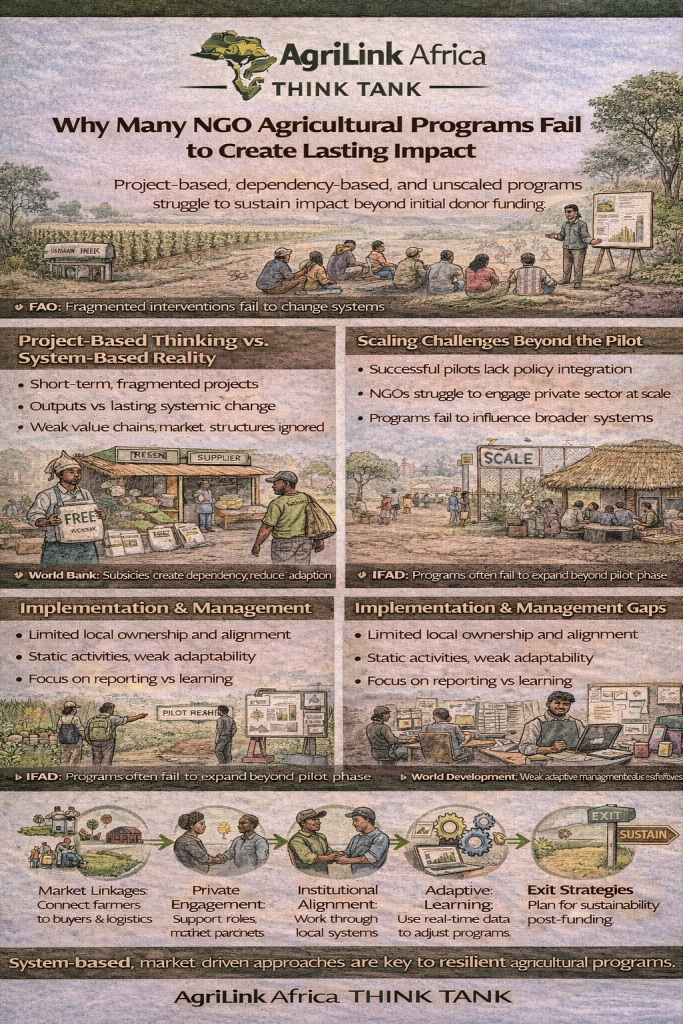
NGO agricultural programs in Africa have expanded rapidly over the past two decades, yet evidence shows that many struggle to create lasting, system-level impact beyond project lifecycles. Across Africa, billions of dollars have been invested in agricultural development projects over the past decades, yet productivity gaps, farmer vulnerability, and food insecurity remain stubbornly high. While some interventions deliver short-term gains, many struggle to generate durable, system-level change once donor funding ends.
Evidence increasingly suggests that the challenge lies less in what is funded and more in how agricultural development programs are conceptualized, implemented, and integrated into local market systems.
Project-Based Thinking vs System-Based Reality
A central limitation of many NGO agricultural programs is their reliance on project-based thinking rather than system-based design. Projects are typically time-bound, geographically constrained, and evaluated against predefined outputs such as number of farmers trained or inputs distributed. However, agricultural livelihoods operate within complex systems involving markets, infrastructure, finance, climate, and institutions.
The Food and Agriculture Organization notes that fragmented, short-term interventions often fail to address structural constraints such as weak value chains, poor market access, and policy misalignment FAO, 2018. As a result, gains achieved during project cycles frequently dissipate once external support is withdrawn.
System-based approaches, by contrast, focus on strengthening the underlying functions of agricultural ecosystems—information flows, incentives, coordination, and resilience—rather than delivering isolated activities.
Dependency Risks and Distorted Incentives
Another major reason why many NGO agricultural programs fail is the unintended creation of dependency. Input subsidies, free asset distribution, and heavily subsidized services can temporarily boost adoption, but they often undermine local markets and farmer self-reliance.
Research by the World Bank shows that prolonged reliance on externally provided inputs can crowd out private suppliers and weaken farmer incentives to invest independently World Bank, 2019. When programs end, farmers may face higher costs, reduced access, and limited alternatives, leading to adoption collapse.
Moreover, NGOs themselves can become trapped in incentive structures that prioritize donor reporting requirements over long-term sustainability, reinforcing a cycle of repeated pilots rather than scalable solutions.
Scaling Challenges Beyond the Pilot Phase
Many agricultural development programs demonstrate success at pilot scale but fail to expand meaningfully. Scaling requires more than replication; it demands alignment with national institutions, private sector actors, and policy frameworks.
According to the International Fund for Agricultural Development, successful scaling depends on embedding interventions within existing market and governance systems rather than operating parallel structures IFAD, 2020. However, NGO programs often lack the mandate or capacity to influence policy, invest in infrastructure, or engage commercial actors at scale.
As a result, promising innovations remain localized, donor-dependent, and disconnected from broader agricultural transformation pathways.
Management and Implementation Gaps
Operational capacity is another overlooked constraint. Agricultural development is inherently complex, requiring coordination across multiple actors and disciplines. Yet many programs are implemented through fragmented management structures with limited local ownership.
Studies published in World Development highlight that weak monitoring systems, insufficient feedback loops, and limited adaptive management reduce program effectiveness in dynamic environments World Development, 2017. Without real-time learning and adjustment, interventions struggle to respond to climatic shocks, market volatility, or behavioral barriers.
What Successful Programs Do Differently
Despite these challenges, some agricultural programs have demonstrated lasting impact. Evidence suggests that successful initiatives share several common characteristics:
- Market integration: Programs link farmers to buyers, finance, and logistics rather than focusing solely on production AGRA, 2021.
- Private sector engagement: Sustainable models leverage commercial incentives instead of substituting them.
- Institutional alignment: Interventions complement national strategies and strengthen local institutions rather than bypassing them.
- Data-driven adaptation: Continuous learning and feedback inform program adjustments.
- Exit strategies: Clear transition plans ensure continuity beyond donor funding.
These elements shift the focus from delivery to durability.
Rethinking Agricultural Development Models
To address why many NGO agricultural programs fail, development actors must rethink their operating models. This means moving from projects to platforms, from beneficiaries to market participants, and from delivery to enablement.
Policy frameworks increasingly emphasize systems thinking, public-private collaboration, and digital infrastructure as enablers of scale OECD, 2021. In Africa, this shift is particularly critical given rapid urbanization, climate pressure, and demographic change.
Rather than asking how many farmers were reached, the more relevant question becomes: Which systems were strengthened, and will they continue to function without external support?
Conclusion
The persistence of limited impact in agricultural development is not evidence of failure of effort, but of outdated design logic. Why many NGO agricultural programs fail is ultimately a systems question. Without addressing incentives, markets, institutions, and scalability, even well-funded interventions struggle to deliver lasting transformation.
For Africa’s agriculture to transition from aid-dependence to resilience, development programs must evolve from isolated projects into integrated components of functioning agricultural ecosystems.

Abenezer Wondimagegn is the Founder & CEO of AgriLink Africa, a Research & Data Analyst, and Article Publisher. He specializes in Agriculture, Supply Chain, Logistics, Nutrition, E-commerce, and Business Investment. Through his work, he empowers farmers, strengthens food systems, and shares insights to drive innovation and sustainable growth in Ethiopia’s agricultural sector.

