
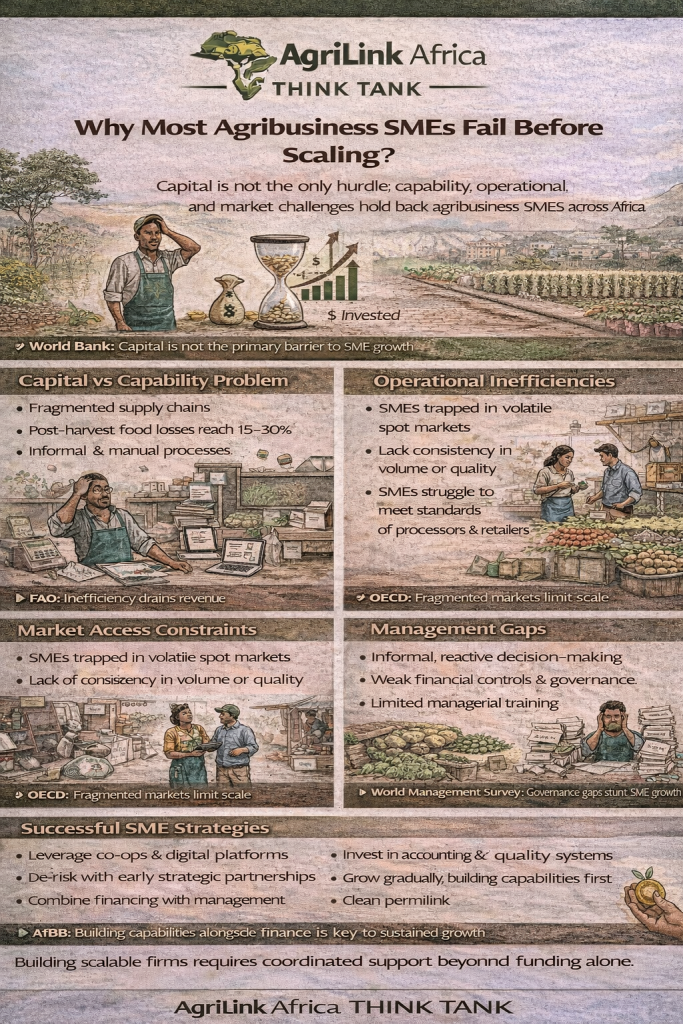
Agribusiness SMEs in Africa are central to food production, processing, and distribution across the continent, yet the majority fail before reaching scale. Despite growing policy attention and increased access to finance, structural weaknesses in operational capability, market integration, and management systems continue to limit their long-term viability and growth.
According to development finance institutions, over 70% of agribusiness SMEs in Sub-Saharan Africa stagnate or exit within their first five years World Bank, 2019. Understanding why this happens is essential for designing effective support systems, investment strategies, and policies that move beyond startup creation toward sustainable enterprise growth.
Capital Constraints Are Only Part of the Problem
Access to finance is often cited as the primary bottleneck for agribusiness SMEs. While undercapitalization is real, evidence suggests that capital without capability rarely delivers scale.
Studies show that many SMEs fail even after receiving loans or grants because funds are absorbed by inefficiencies rather than productivity gains IFC, 2020. Weak financial management, poor cash-flow planning, and limited cost controls often result in capital leakage rather than expansion.
In agriculture, long production cycles, seasonal revenues, and price volatility further amplify financial risk. Without strong internal systems, additional capital can accelerate failure instead of preventing it.
Operational Inefficiencies Limit Growth Potential
Operational inefficiency is one of the most persistent barriers to agribusiness scaling. Many SMEs rely on manual processes, fragmented supply chains, and informal procurement systems that increase costs and reduce reliability.
Research on African agribusinesses shows that post-harvest losses alone can account for 15–30% of enterprise-level revenue erosion, particularly in horticulture, dairy, and grains FAO, 2019. Inefficient storage, inconsistent quality control, and lack of basic logistics coordination limit the ability of SMEs to meet larger buyer requirements.
Scaling requires repeatability. When operations are not standardized, growth increases complexity rather than efficiency—pushing firms beyond their management capacity.
Market Access Remains Structurally Constrained
Even productive agribusiness SMEs struggle to scale without stable and diversified market access. Many remain trapped in spot markets characterized by price volatility, information asymmetry, and dominant intermediaries.
Formal buyers—such as processors, retailers, and exporters—require consistency in volume, quality, and delivery schedules. However, most SMEs lack the aggregation capacity, certifications, or logistics reliability needed to meet these standards OECD, 2021.
As a result, SMEs operate in fragmented markets with thin margins, making reinvestment and expansion difficult. Digital marketplaces and contract farming models are beginning to address this gap, but adoption remains uneven across regions.
Management and Governance Gaps
Management capability is one of the strongest predictors of SME survival and growth. Evidence from enterprise surveys indicates that firms with weak governance structures are significantly less likely to scale, regardless of sector Bloom et al., World Management Survey, 2018.
In agribusiness, founders often combine technical expertise with entrepreneurial drive but lack experience in strategic planning, human resource management, and performance monitoring. Decision-making remains centralized, informal, and reactive—limiting organizational learning and resilience.
Without governance systems that separate ownership from operations, scaling increases risk exposure rather than stability.
What Successful Agribusiness SMEs Do Differently
Evidence from high-performing agribusiness SMEs across Africa reveals a consistent set of differentiators:
- They invest early in systems, not just assets—accounting, inventory management, and quality control.
- They integrate into structured markets, using contracts, cooperatives, or digital platforms to stabilize demand.
- They professionalize management, delegating operations and using data to guide decisions.
- They grow incrementally, aligning expansion with operational readiness rather than chasing rapid scale.
- They leverage partnerships, including logistics providers, financial institutions, and extension services.
A study of agribusiness SMEs supported by blended finance programs found that firms combining capital with technical assistance were twice as likely to achieve sustained growth compared to those receiving finance alone African Development Bank, 2022.
Conclusion
The failure of agribusiness SMEs before scaling is not inevitable. It is the result of systemic mismatches between finance, capability, markets, and management. Policies and investments that focus solely on increasing the number of startups risk perpetuating a cycle of fragile enterprises.
For Africa’s agribusiness sector to deliver employment, food security, and economic transformation, the focus must shift toward building scalable firms, not just launching new ones. This requires coordinated interventions that strengthen operational systems, market integration, and managerial capacity alongside access to finance.
Scaling is not an event. It is a system.
AgriLink Africa Think Tank
Where African Agricultural Intelligence Is Written

Abenezer Wondimagegn is the Founder & CEO of AgriLink Africa, a Research & Data Analyst, and Article Publisher. He specializes in Agriculture, Supply Chain, Logistics, Nutrition, E-commerce, and Business Investment. Through his work, he empowers farmers, strengthens food systems, and shares insights to drive innovation and sustainable growth in Ethiopia’s agricultural sector.

