
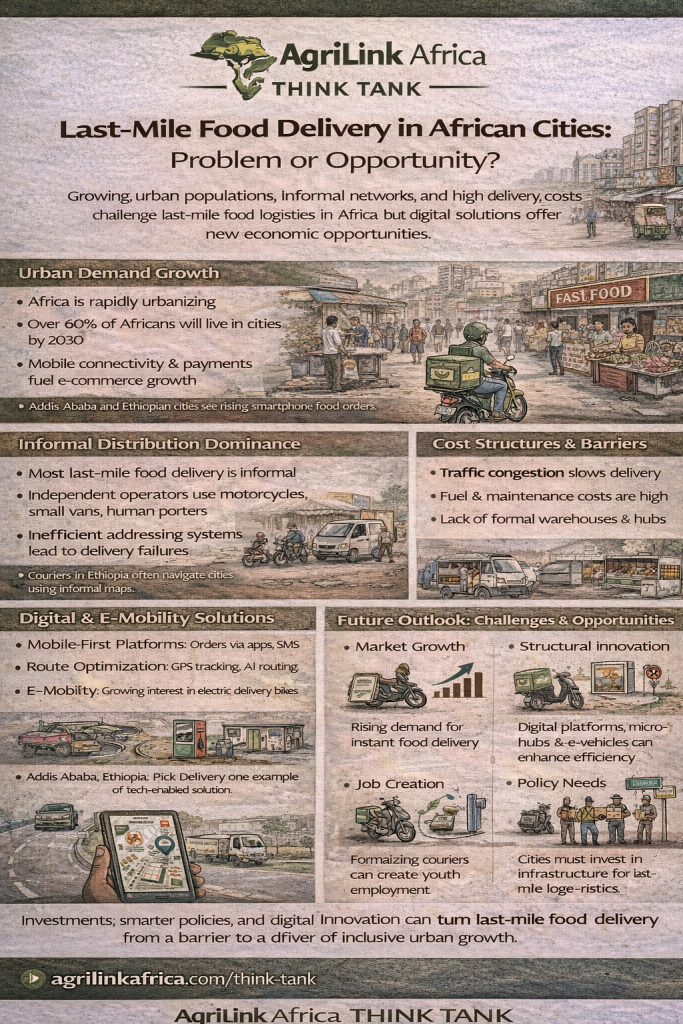
The Urban Food Pressure Point
Last-mile food delivery in African cities is emerging as one of the most critical—and least understood—pressure points in Africa’s urban food systems. As cities expand rapidly and food demand intensifies, the ability to move fresh, affordable food efficiently from markets to consumers has become a defining challenge for food security, livelihoods, and urban resilience across the continent.
Africa is urbanizing faster than any other region in the world. By 2030, more than 60% of Africa’s population is projected to live in cities, adding over 300 million new urban consumers within a single decade UN DESA, 2019
This rapid urban growth is reshaping food demand—but it is also exposing a fragile reality: last-mile food delivery systems in African cities are structurally weak.
Fresh food may enter cities in bulk, but it often fails at the final step—getting food from wholesale markets to households, retailers, restaurants, and informal vendors efficiently, affordably, and safely. This final stretch, known as the last mile, has become one of the most expensive and inefficient segments of Africa’s food system.
The question is no longer whether last-mile delivery is a problem—but whether it can become one of Africa’s largest food system opportunities.
Urban Demand Growth: A Structural Shift, Not a Trend
Urban food demand in Africa is no longer driven only by population growth. It is shaped by changing lifestyles, smaller household sizes, rising female labor participation, and time constraints that favor convenience and delivery services World Bank, 2020
In cities like Addis Ababa, Nairobi, Lagos, and Accra:
- Daily food purchases are replacing weekly bulk shopping
- Demand for fresh produce, prepared foods, and rapid delivery is increasing
- Informal food vendors still supply over 70% of urban food consumption
Yet food distribution systems remain designed for rural-to-market transport, not for dense, time-sensitive urban delivery.
Informal Distribution Dominance: Strength and Weakness
Last-mile food delivery in African cities is overwhelmingly informal. Independent couriers, pushcart vendors, motorcycle riders, and small traders form decentralized networks that move food every day without digital systems, contracts, or standardized pricing.
This informality provides flexibility and employment, but it also creates systemic weaknesses:
- No route optimization or delivery coordination
- High post-market food loss due to delays and poor handling
- Limited accountability for food safety and quality
- Price volatility driven by fragmented supply flows
Studies show that urban food losses during distribution can reach 15–25%, even after food has already arrived in city wholesale markets FAO, 2019
Cost Structures: Why the Last Mile Is So Expensive
Contrary to common assumptions, the last mile can account for up to 40–50% of total food logistics costs in African cities World Bank, 2022.
Key cost drivers include:
- Traffic congestion and poor road planning
- High fuel and vehicle maintenance costs
- Inefficient routing and empty return trips
- Lack of neighborhood-level aggregation hubs
In Addis Ababa, small food traders often make multiple trips per day from wholesale markets like Atkilt Tera to neighborhoods, each trip adding cost, spoilage risk, and price markups for consumers.
Digital and E-Mobility Solutions: Ethiopia as a Case Example
Ethiopia offers a revealing case of both constraint and opportunity.
Mobile penetration in urban Ethiopia has increased rapidly, with over 40 million mobile subscribers nationwide Ethio Telecom, 2023 . This has enabled the emergence of food delivery platforms, digital ordering systems, and courier networks—particularly in Addis Ababa.
Early digital food delivery platforms demonstrate several structural advantages:
- Order aggregation reduces redundant trips
- GPS-enabled routing improves delivery time
- Mobile payments reduce cash handling risks
- Electric bikes lower fuel and maintenance costs
Pilot studies across African cities show that electric delivery bikes can reduce last-mile delivery costs by 20–30% compared to fuel motorcycles in dense urban areas UN Environment Programme, 2021.
However, these solutions remain limited by:
- Access to affordable financing for vehicles
- Lack of micro-hubs for food aggregation
- Weak integration with informal traders
COVID-19 and Climate Stress: Lessons Learned
The COVID-19 pandemic exposed how fragile urban food delivery systems truly are. Lockdowns disrupted informal transport, reduced market access, and caused sharp food price spikes across African cities IFPRI, 2021.
Climate shocks—such as floods, heatwaves, and fuel supply disruptions—now compound these vulnerabilities. Cities without resilient last-mile systems experience faster food inflation and greater food insecurity during crises.
These shocks made one thing clear: last-mile delivery is not a convenience layer—it is critical infrastructure.
From Problem to Opportunity: Building Resilient Urban Food Delivery
Transforming last-mile food delivery in Africa requires system-level thinking, not isolated startups.
Key interventions include:
1. Neighborhood Food Hubs
Micro-distribution hubs near consumption centers reduce travel distance, enable cold storage, and support aggregation for informal traders.
2. Platform-Enabled Informality
Digital platforms should integrate—not replace—informal traders by offering logistics, pricing transparency, and payment systems.
3. E-Mobility Incentives
Public-private partnerships can accelerate electric bike adoption through leasing models and charging infrastructure.
4. Data-Driven Urban Food Planning
Cities need food logistics data integrated into transport and land-use planning frameworks UN-Habitat, 2020.
Conclusion: A Structural Opportunity Hiding in Plain Sight
Last-mile food delivery in African cities is often framed as a logistical headache. In reality, it is a high-impact leverage point for food affordability, employment, emissions reduction, and system resilience.
The future of African urban food systems will not be decided only on farms or in wholesale markets—but on motorcycles, electric bikes, micro-hubs, and mobile platforms navigating the final kilometers to consumers.
Handled poorly, the last mile will continue to inflate prices and waste food.
Handled strategically, it can become one of Africa’s most powerful food system upgrades.
AgriLink Africa Think Tank
Where African Agricultural Intelligence Is Written

Abenezer Wondimagegn is the Founder & CEO of AgriLink Africa, a Research & Data Analyst, and Article Publisher. He specializes in Agriculture, Supply Chain, Logistics, Nutrition, E-commerce, and Business Investment. Through his work, he empowers farmers, strengthens food systems, and shares insights to drive innovation and sustainable growth in Ethiopia’s agricultural sector.

