
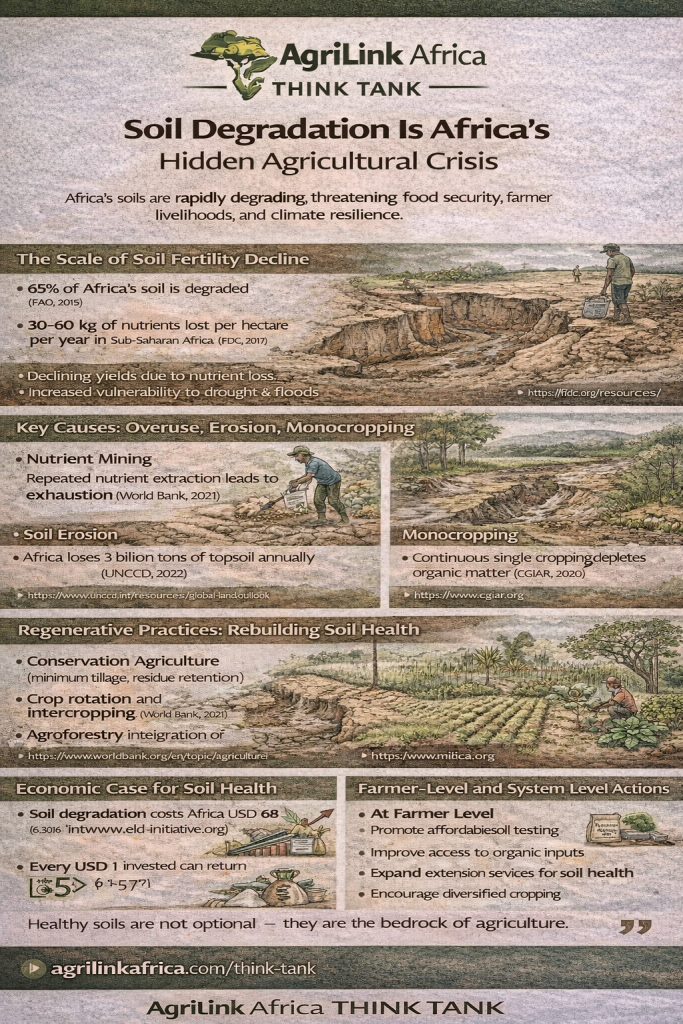
Soil degradation in Africa is quietly eroding the foundations of the continent’s agricultural economy. While debates often focus on seeds, fertilizers, and market access, the slow decline of soil fertility remains one of the most overlooked drivers of low productivity, food insecurity, and climate vulnerability across African farming systems.
This silent decline threatens food security, farmer incomes, climate resilience, and long-term agricultural sustainability.
The Scale of Soil Fertility Decline
Soil degradation in Africa is widespread and accelerating. According to the Food and Agriculture Organization (FAO, 2015), nearly 65% of Africa’s arable land is degraded, primarily due to nutrient depletion and erosion FAO, 2015.
Sub-Saharan African soils lose an estimated 30–60 kg of nutrients per hectare per year, far exceeding replenishment rates IFDC, 2017
This results in:
- Declining crop yields despite expanded cultivation
- Increased vulnerability to drought and floods
- Rising production costs with diminishing returns
Soil degradation is not an isolated environmental issue — it is a systemic productivity failure.
Key Causes: Overuse, Erosion, and Monocropping
1. Nutrient Mining
Smallholder farmers often extract nutrients season after season without adequate replenishment. Limited access to fertilizers and organic matter accelerates soil exhaustion World Bank, 2021
2. Soil Erosion
Water and wind erosion remove fertile topsoil, especially in highland regions of Ethiopia, Kenya, and Rwanda. The UNCCD 2022 estimates Africa loses over 3 billion tons of topsoil annually
3. Monocropping and Poor Land Management
Repeated planting of single crops without rotation reduces soil organic matter and disrupts soil biology CGIAR, 2020
These practices are often driven by necessity rather than choice, highlighting the need for systemic solutions.
Regenerative Practices: Rebuilding Soil Health
Evidence shows that regenerative and climate-smart practices can restore soil productivity:
- Conservation agriculture (minimum tillage, residue retention)
- Crop rotation and intercropping
- Agroforestry systems
- Organic matter integration (compost, manure)
- Integrated soil fertility management (ISFM)
The International Institute of Tropical Agriculture IITA, 2019 found yield increases of 30–100% when ISFM practices were applied consistently
These practices improve:
- Soil structure
- Water retention
- Nutrient efficiency
- Long-term resilience
However, adoption remains limited without institutional support.
The Economic Case for Soil Health
Soil degradation carries substantial economic costs. The Economics of Land Degradation ELD Initiative, 2018 estimates Africa loses USD 68 billion annually due to land degradation
Conversely, investing in soil restoration delivers high returns:
- Every USD 1 invested can generate USD 5–7 in economic benefits (ELD, 2018)
- Reduced input dependency
- Higher yield stability
- Increased land value
Soil health is not a cost — it is a high-return investment.
Farmer-Level and System-Level Actions
At Farmer Level
- Promote affordable soil testing
- Improve access to organic inputs
- Expand extension services focused on soil management
- Encourage diversified cropping systems
At System Level
- Integrate soil health into national agricultural strategies
- Redirect subsidies toward regenerative practices
- Build soil data systems and monitoring platforms
- Align climate finance with soil restoration programs
The African Union’s CAADP framework increasingly recognizes soil health as foundational to agricultural transformation AU, 2020
Despite its scale and economic impact, soil degradation in Africa remains largely invisible in policy and investment discussions. Unlike droughts or floods, soil fertility loss is gradual, cumulative, and often hidden beneath short-term yield fluctuations driven by fertilizer use. This makes it harder to measure, easier to ignore, and politically less urgent.
Most agricultural strategies prioritize visible interventions — seed distribution, mechanization, irrigation — while soil health is treated as a background assumption rather than a core asset. As a result, public budgets rarely allocate sufficient resources for soil testing, extension-led regenerative practices, or long-term land stewardship incentives.
Without elevating soil health to a first-order policy concern, productivity gains achieved today risk being offset by declining land quality tomorrow, locking farmers into a cycle of rising input costs and diminishing returns.
Conclusion
Soil degradation is Africa’s hidden agricultural crisis — largely ignored, poorly measured, and dangerously underestimated. Productivity gains achieved without restoring soil health are temporary and fragile.
Sustainable agricultural growth in Africa will not come from inputs alone. It will come from rebuilding the biological and physical foundation of farming systems.
Healthy soils are not optional.
They are the infrastructure of agriculture.
AgriLink Africa Think Tank
Where African Agricultural Intelligence Is Written

Abenezer Wondimagegn is the Founder & CEO of AgriLink Africa, a Research & Data Analyst, and Article Publisher. He specializes in Agriculture, Supply Chain, Logistics, Nutrition, E-commerce, and Business Investment. Through his work, he empowers farmers, strengthens food systems, and shares insights to drive innovation and sustainable growth in Ethiopia’s agricultural sector.

