
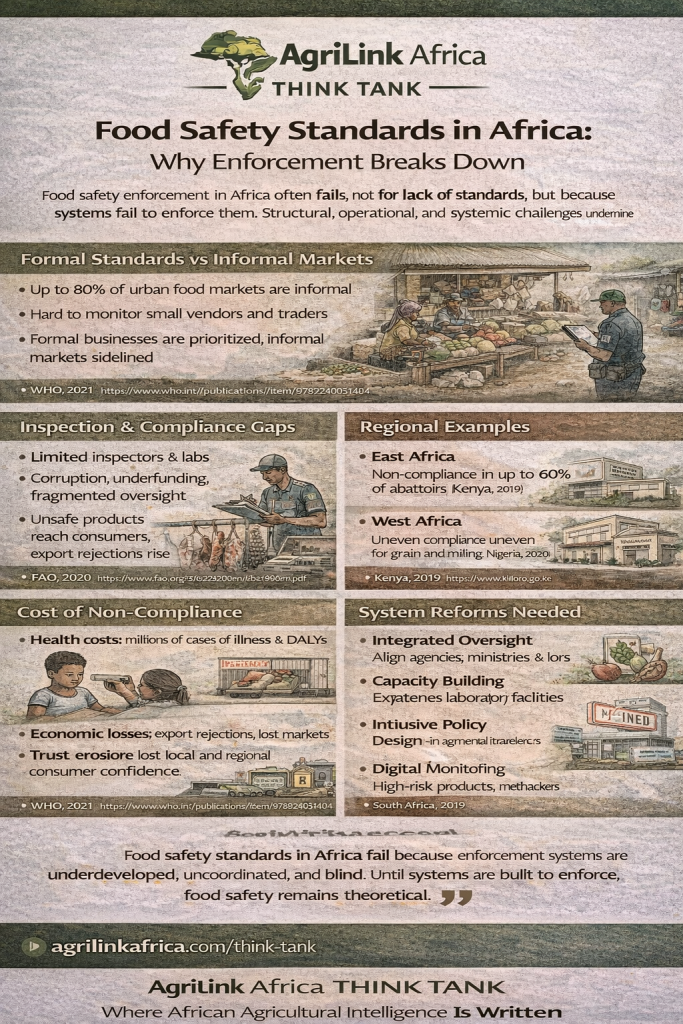
Food safety is central to health, trade, and economic growth. In Africa, regulatory frameworks exist to ensure that foods reaching consumers are safe. Governments, regional bodies, and international agencies have established standards covering production, processing, transport, and retail. Yet, despite these frameworks, enforcement consistently fails, resulting in persistent risks to public health, lost market opportunities, and reduced trust in domestic and regional markets.
The breakdown is not simply a matter of weak laws. It is the result of structural, operational, and systemic challenges that prevent food safety standards from being applied effectively.
Formal Standards vs Informal Markets
Africa’s food systems are heavily dualistic. On one side, formal systems operate under codified rules, regulatory oversight, and certification requirements. On the other side, informal markets dominate food distribution, especially for fresh produce, grains, and animal products.
The World Health Organization (WHO, 2021) notes that informal markets account for up to 80% of food sales in urban Sub-Saharan Africa WHO, 2021
This duality creates enforcement challenges:
- Regulatory standards are difficult to apply outside formal channels
- Small-scale vendors and informal aggregators are hard to monitor
- Informal actors often lack access to training, infrastructure, or certification
- Enforcement agencies prioritize formal businesses, leaving informal markets largely unchecked
Food safety enforcement cannot succeed without addressing the scale and dominance of informal markets.
Inspection and Compliance Gaps
Even within formal sectors, compliance remains uneven. Governments frequently struggle with:
- Limited inspection capacity
- Inadequate laboratory facilities
- Low enforcement staffing
- Corruption and underfunding
- Fragmented oversight across ministries
The Food and Agriculture Organization (FAO, 2020) highlights insufficient inspection and monitoring as major contributors to foodborne disease outbreaks in African countries FAO, 2020
Consequences include:
- Unsafe products reaching consumers
- Export rejections in regional and international markets
- Weak deterrence for non-compliant businesses
Inspection without system-level enforcement mechanisms is largely symbolic.
Regional Examples
East Africa
In Kenya, meat safety inspections are formalized through county-level veterinary offices. Despite regulation, studies show that up to 60% of slaughterhouses fail to comply fully with hygiene standards due to limited capacity and poor coordination Kenya Ministry of Agriculture, 2019
West Africa
In Nigeria, grain storage and milling operations operate under the National Agency for Food and Drug Administration and Control (NAFDAC). Compliance remains uneven, particularly among small processors and rural traders NAFDAC, 2020
Southern Africa
South Africa’s formal food sector demonstrates better compliance, but enforcement in informal urban markets remains a challenge, particularly for perishable goods sold in street markets Department of Agriculture, Forestry & Fisheries, 2019
These examples illustrate a recurring theme: formal rules exist, but operational realities prevent full implementation.
Cost of Non-Compliance
The consequences of weak enforcement are measurable:
- Health costs: Foodborne illnesses cost millions of DALYs (Disability Adjusted Life Years) annually (WHO, 2021)
- Economic losses: Export rejections, market closure, and reduced trade volumes impact livelihoods and GDP
- Trust erosion: Consumers and buyers lose confidence in local food systems
- Investment deterrence: Private investors hesitate to fund agribusinesses with unpredictable regulatory enforcement
Enforcement failure is therefore not just a regulatory problem, but a systemic economic and public health challenge.
System Reforms Needed
To strengthen food safety enforcement in Africa, reforms must address both structural and operational gaps:
- Integrated Oversight Systems
- Align agencies, ministries, and regional authorities
- Create unified inspection and monitoring frameworks
- Capacity Building
- Train inspectors
- Expand laboratory and testing infrastructure
- Equip enforcement personnel with digital reporting tools
- Inclusive Policy Design
- Incorporate informal markets into regulatory planning
- Provide certification pathways and incentives for small-scale actors
- Support public-private partnerships for market compliance
- Digital Monitoring and Traceability
- Track food movement from production to retail
- Use IoT sensors, QR codes, and blockchain for high-value crops
- Share real-time data with regulators and stakeholders
- Risk-Based Enforcement
- Prioritize high-risk products and high-volume markets
- Use data-driven targeting for inspections
The World Bank (2020) emphasizes that system reforms, digital platforms, and coordinated oversight are essential to improve food safety compliance in Africa World Bank, 2020
Conclusion
Food safety enforcement in Africa fails not because standards do not exist — but because systems, resources, and implementation structures are insufficient.
Effective enforcement requires:
- integrated institutions
- digital monitoring
- risk-based approaches
- inclusive policies that engage informal markets
Until these reforms are implemented, foodborne risks, market inefficiencies, and economic losses will continue to undermine African agriculture.
Food safety standards are only as strong as the system that enforces them. Building robust, data-driven, inclusive enforcement systems is not optional — it is a foundation for public health, economic growth, and regional trade.
AgriLink Africa Think Tank
Where African Agricultural Intelligence Is Written

Abenezer Wondimagegn is the Founder & CEO of AgriLink Africa, a Research & Data Analyst, and Article Publisher. He specializes in Agriculture, Supply Chain, Logistics, Nutrition, E-commerce, and Business Investment. Through his work, he empowers farmers, strengthens food systems, and shares insights to drive innovation and sustainable growth in Ethiopia’s agricultural sector.

