
For decades, African agriculture has operated largely on experience, tradition, and intuition. Farmers made decisions based on rainfall patterns remembered from past seasons, inherited knowledge, and informal market signals. While this adaptive intelligence sustained communities for generations, it now struggles to cope with climate variability, market volatility, population growth, and complex value chains.
Today, a fundamental shift is underway. African agriculture is moving from guesswork to intelligence — driven by data systems that transform decision-making, productivity, logistics, and market efficiency. This transformation is not merely technological; it is structural, redefining how food systems function across the continent.
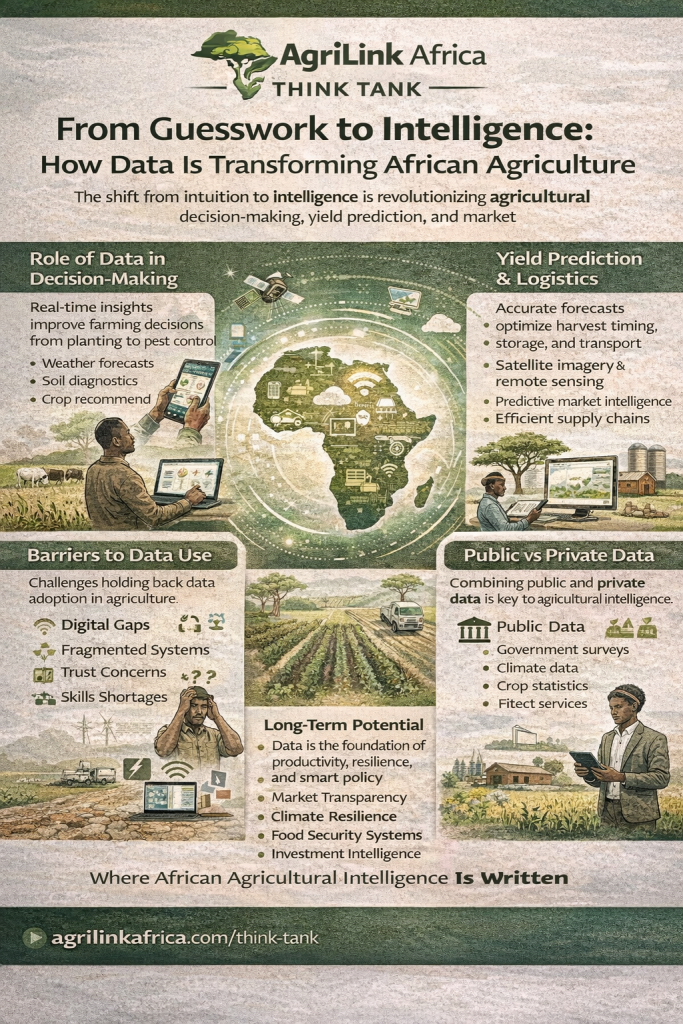
The Role of Data in Decision-Making
Data is rapidly becoming the foundation of modern agricultural decision-making. From soil diagnostics and climate analytics to market pricing systems and digital advisory platforms, information is now guiding actions that were once based on estimation.
The Food and Agriculture Organization (FAO, 2021) emphasizes that data-driven agriculture improves resource efficiency, risk management, and productivity by enabling farmers and institutions to make predictive rather than reactive decisions FAO, 2021
Digital advisory platforms now provide farmers with:
- weather forecasting
- soil health information
- crop recommendations
- pest and disease alerts
- planting calendars
- fertilizer optimization guidance
This shift reduces uncertainty and transforms farming into a managed production system rather than a survival activity.
Yield Prediction and Logistics Optimization
One of the most powerful applications of data lies in yield prediction and logistics planning. Accurate forecasting allows governments, agribusinesses, and logistics operators to anticipate production volumes, manage storage, and design distribution systems.
The World Bank (2022) reports that predictive analytics in agriculture significantly reduce post-harvest losses and supply chain inefficiencies by enabling proactive storage and transport planning World Bank, 2022
Satellite imagery, remote sensing, and AI-driven modeling are now being used across Africa to:
- forecast harvest volumes
- predict drought and flood risks
- optimize transport routes
- plan cold-chain capacity
- reduce market shocks
In countries such as Kenya and Rwanda, digital yield prediction tools are already supporting aggregation centers and market platforms in aligning supply with demand.
Barriers to Data Use
Despite its potential, data adoption in African agriculture remains uneven due to systemic barriers:
1. Digital Infrastructure Gaps
Limited connectivity, electricity access, and digital literacy constrain data access in rural areas. The International Telecommunication Union (ITU, 2022) reports that rural broadband penetration in Sub-Saharan Africa remains below 30%, limiting digital service reach ITU, 2022
2. Fragmented Data Systems
Agricultural data is often siloed across ministries, NGOs, startups, and private companies, preventing integration into unified intelligence systems.
3. Trust and Data Ownership Concerns
Farmers and institutions are often reluctant to share data due to fears of misuse, exploitation, or loss of control.
4. Skills and Capacity Constraints
Limited technical capacity in data science, analytics, and digital agriculture slows institutional adoption.
These barriers are not technological alone — they are governance, infrastructure, and institutional challenges.
Public vs Private Data Systems
Data transformation in African agriculture is shaped by the interaction between public and private data systems.
Public Data
Governments collect data on:
- land use
- production statistics
- climate patterns
- trade flows
- food security indicators
Institutions such as FAO, World Bank, and national statistical agencies provide open datasets that support policy design and planning.
Private Data
Private platforms generate real-time data through:
- digital marketplaces
- farm management apps
- logistics platforms
- fintech services
- agri-tech solutions
The OECD (2020) notes that private data ecosystems increasingly shape agricultural markets through platform-based intelligence systems OECD, 2020
The future lies in interoperability — connecting public and private data into integrated intelligence systems that serve farmers, markets, and institutions simultaneously.
The Long-Term Potential of Data-Driven Agriculture
Data is not simply a tool — it is the foundation of system transformation.
Long-term impacts include:
1. Market Transparency
Real-time pricing and demand forecasting reduce exploitation and improve farmer incomes.
2. Climate Resilience
Predictive climate modeling strengthens adaptation strategies.
3. Food Security Systems
Data enables proactive food system planning instead of crisis response.
4. Investment Intelligence
Investors gain risk visibility, performance data, and market signals.
5. Policy Precision
Governments shift from generalized policies to targeted interventions.
The African Development Bank (AfDB, 2023) highlights that digital agriculture and data systems are central to Africa’s long-term agricultural competitiveness and food system resilience AfDB, 2023
Conclusion
African agriculture is entering a new era — one where intelligence replaces intuition, and systems replace guesswork.
Data is transforming agriculture by:
- improving decision-making
- optimizing logistics
- strengthening markets
- enabling resilience
- improving productivity
- creating transparency
- supporting policy
- guiding investment
But this transformation will not happen automatically. It requires:
- digital infrastructure investment
- data governance frameworks
- interoperability standards
- farmer inclusion models
- institutional coordination
- ethical data systems
- trusted platforms
The future of African agriculture will not be built only on seeds, soil, and water —
it will be built on data, intelligence, and systems design.
From guesswork to intelligence — this is the real transformation of African agriculture.
AgriLink Africa Think Tank
Where African Agricultural Intelligence Is Written

Abenezer Wondimagegn is the Founder & CEO of AgriLink Africa, a Research & Data Analyst, and Article Publisher. He specializes in Agriculture, Supply Chain, Logistics, Nutrition, E-commerce, and Business Investment. Through his work, he empowers farmers, strengthens food systems, and shares insights to drive innovation and sustainable growth in Ethiopia’s agricultural sector.

