
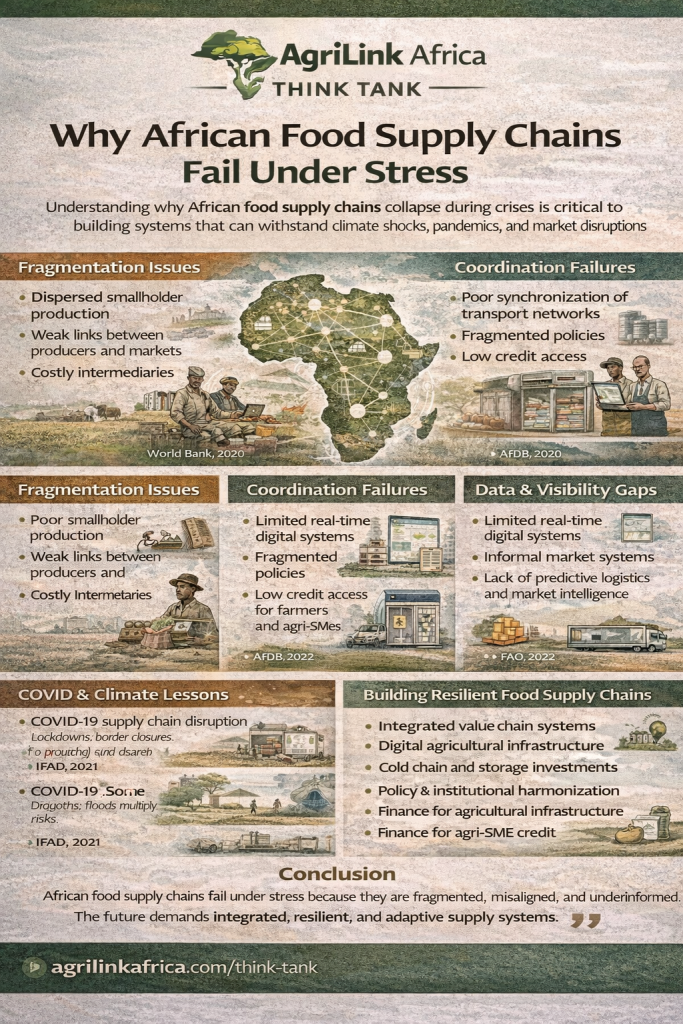
African food supply chains function under normal conditions, but they often collapse when exposed to shocks. Pandemics, climate events, political disruptions, fuel price spikes, border closures, and logistics interruptions consistently reveal deep structural weaknesses across production, aggregation, transport, storage, and distribution systems.
These failures are not accidental — they are systemic. They are the result of fragmentation, coordination failures, data blindness, and weak system integration. Stress does not create the problem; it exposes it.
Fragmentation Issues
African food systems are structurally fragmented across every stage of the value chain. Production is dominated by millions of dispersed smallholders, aggregation is informal, logistics networks are weakly connected, storage infrastructure is limited, and market access is uneven.
The Food and Agriculture Organization (FAO, 2022) identifies fragmented production systems and weak market linkages as core drivers of supply chain inefficiency and vulnerability in Sub-Saharan Africa FAO, 2022
Smallholder farmers operate largely outside structured supply systems, relying on informal traders and fragmented intermediaries. This creates:
- weak producer–market linkages
- high transaction costs
- price volatility
- limited traceability
- supply unpredictability
Fragmentation prevents system coordination, making stress absorption almost impossible.
Coordination Failures
Coordination is the backbone of resilient supply chains — and it remains one of Africa’s greatest structural weaknesses.
Transport systems, storage facilities, market platforms, financial services, and regulatory frameworks often operate in isolation rather than as integrated systems.
The African Development Bank (AfDB, 2020) highlights poor inter-sector coordination and institutional fragmentation as key constraints to resilient agricultural supply systems in Africa AfDB, 2020
Coordination failures manifest through:
- unsynchronized transport networks
- policy misalignment between ministries
- fragmented trade regulations
- disconnected logistics planning
- parallel institutional mandates
- weak public–private collaboration
Without coordination, supply chains become collections of actors, not systems — making them structurally fragile under pressure.
Data and Visibility Gaps
Data blindness is one of the most critical vulnerabilities in African food supply chains. Most systems lack real-time visibility on:
- production volumes
- storage capacity
- transport flows
- market demand
- price movements
- logistics bottlenecks
The World Bank (2022) identifies limited data integration and weak digital infrastructure as major barriers to resilient agri-food supply chains World Bank, 2022
Without data:
- shocks cannot be anticipated
- responses are reactive
- logistics planning is blind
- market signals are delayed
- supply–demand mismatches increase
- crisis response becomes chaotic
Supply chains fail not because shocks occur — but because systems cannot see them coming.
COVID-19 and Climate Lessons
COVID-19 Shock
The COVID-19 pandemic exposed the structural fragility of African food systems. Lockdowns, border closures, transport disruptions, and labor shortages caused widespread breakdowns in food distribution networks.
The International Fund for Agricultural Development (IFAD, 2021) reports that COVID-19 disrupted food logistics, increased post-harvest losses, and reduced market access for smallholders across Africa IFAD, 2021
Climate Stress
Climate shocks — droughts, floods, heatwaves, and rainfall variability — further amplify vulnerability.
The Intergovernmental Panel on Climate Change (IPCC, 2022) identifies African food systems as among the most climate-vulnerable globally due to weak infrastructure and low adaptive capacity IPCC, 2022
COVID and climate together revealed a core truth:
African supply chains are not designed for resilience — they are designed for survival under normal conditions.
Building Resilient Food Supply Chains
Resilience is not built through isolated projects. It is built through system design.
1. Integrated Value Chain Systems
Supply chains must shift from fragmented actors to integrated systems:
- coordinated production planning
- structured aggregation
- linked logistics networks
- aligned market platforms
2. Digital Agricultural Infrastructure
Digital platforms enable:
- real-time data flows
- predictive logistics
- market transparency
- early warning systems
- supply-demand coordination
The OECD (2020) identifies digital integration as essential for resilient agricultural supply systems OECD, 2020
3. Cold Chain and Storage Investment
Resilience requires physical infrastructure:
- cold storage
- warehouse systems
- processing hubs
- logistics corridors
4. Policy and Institutional Harmonization
Resilience depends on:
- aligned regulations
- coordinated ministries
- integrated planning frameworks
- regional trade integration
5. Finance for System Infrastructure
Capital must shift from short-term projects to:
- logistics infrastructure
- data systems
- market platforms
- aggregation centers
- digital supply networks
Conclusion
African food supply chains do not fail under stress because of shocks.
They fail because they are fragmented, misaligned, under-coordinated, and under-informed.
Stress reveals structure.
COVID did not break African supply chains — it exposed their design.
Climate change does not destabilize food systems — it amplifies existing weaknesses.
Market shocks do not create vulnerability — they reveal it.
The future of African food security will not be secured by increasing production alone.
It will be secured by system intelligence, infrastructure integration, coordination design, data visibility, and institutional alignment.
Resilience is not a response strategy.
It is a structural property of well-designed systems.
Until African food supply chains are built as integrated, data-driven, coordinated systems, they will continue to fail under stress — not because the shocks are too big, but because the structures are too weak.
AgriLink Africa Think Tank
Where African Agricultural Intelligence Is Written

Abenezer Wondimagegn is the Founder & CEO of AgriLink Africa, a Research & Data Analyst, and Article Publisher. He specializes in Agriculture, Supply Chain, Logistics, Nutrition, E-commerce, and Business Investment. Through his work, he empowers farmers, strengthens food systems, and shares insights to drive innovation and sustainable growth in Ethiopia’s agricultural sector.

