
Revolutions do not begin with noise.
They begin with quiet recognition that an existing system no longer works.
A revolution is not change for its own sake. It is a structural shift—a permanent reorganization of how value is created, distributed, and sustained. When a revolution succeeds, returning to the old system becomes impossible, not because it is banned, but because it is obsolete.
In every sector where revolutions occur—agriculture, industry, finance, information—the trigger is the same: pressure meets possibility.
What Truly Triggers a Revolution
Every genuine revolution emerges at the intersection of three forces.
First, pressure.
When inefficiency becomes unbearable, when too many people are excluded, and when the cost of maintaining the old system exceeds the cost of replacing it, pressure accumulates. In African agriculture, this pressure is visible everywhere: low farmer incomes, fragmented markets, post-harvest losses, food insecurity, and increasing climate stress.
Second, capability.
Revolutions do not happen without new tools. Technology, knowledge, or organizational capacity must advance far enough to make a new system viable. Today, Africa has mobile connectivity, digital payments, logistics technology, data infrastructure, and artificial intelligence—capabilities that did not exist during the first Green Revolution.
Third, imagination.
This is the rarest ingredient. Someone must see not just a better product, but a better system. Without imagination, pressure produces collapse, not transformation. With imagination, pressure becomes momentum.
Revolutionizers Are System Builders
A revolutionizer is often misunderstood.
Revolutionizers are not the loudest voices in the room. They are not defined by protest or rhetoric. A revolutionizer is a system builder—someone who replaces a broken logic with a more coherent, scalable, and inclusive operating model.
Revolutionizers do not fight the old system head-on.
They make it irrelevant by building something that works better.
History remembers those who redesign infrastructure, not those who merely criticize it.
Agriculture Has Always Been Revolutionary
Agriculture is not just another sector. It is the foundation upon which societies are built.
The first agricultural revolution enabled human settlement.
The industrial revolution reshaped farming and labor.
The Green Revolution increased yields and fed millions.
But the first Green Revolution was input-driven. It focused on seeds, fertilizers, and production volume. While it succeeded in parts of Asia, it did not translate effectively to Africa—because Africa’s challenge has never been only about yield.
Africa’s agricultural challenge is systemic.
Farmers operate in fragmented markets.
Logistics are weak and expensive.
Information is inconsistent or inaccessible.
Value is captured far from the farm.
Inputs alone cannot fix a broken system.
Africa’s Green Revolution Must Be Different
Africa does not need a repeat of the past.
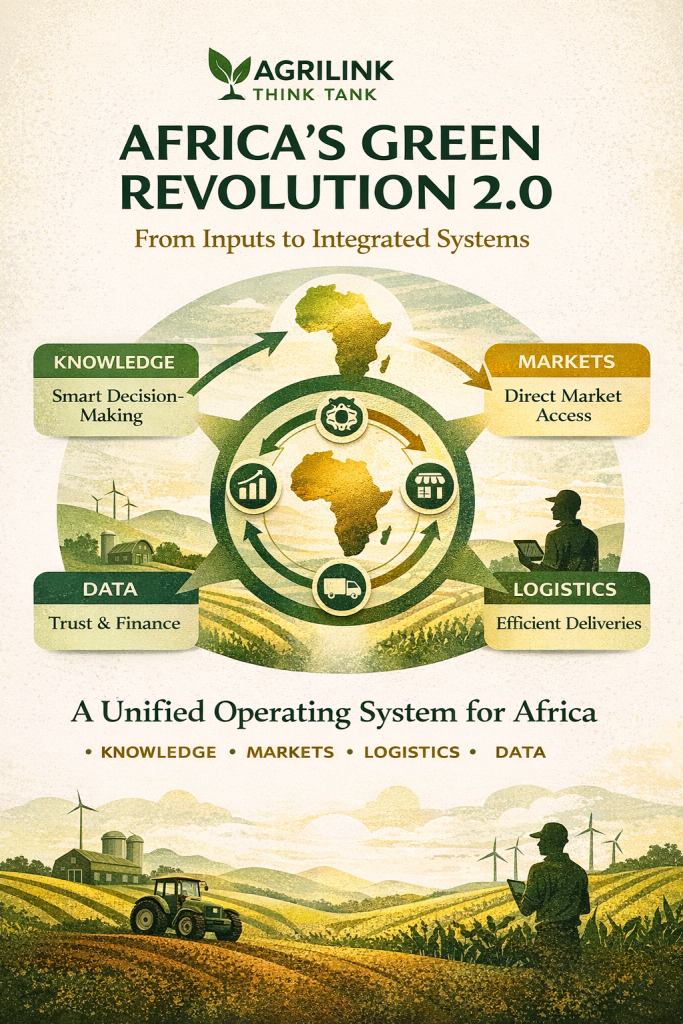
Africa needs a Green Revolution 2.0—one that is system-driven rather than input-driven.
This new revolution must integrate:
- Knowledge with decision-making
- Markets with production
- Logistics with demand
- Data with trust and finance
It must treat the farmer not as a beneficiary, but as the center of the system.
This is not about scaling projects.
It is about designing architecture.
Why We Are Building AgriLink Africa
AgriLink Africa was not conceived as a product.
It was conceived as an operating system.
A unified agricultural infrastructure that connects knowledge, markets, logistics, and data across the value chain—so farmers can make better decisions, access real markets, reduce losses, and participate meaningfully in economic growth.
Revolutions do not scale by funding alone.
They scale by coherence.
If Africa’s agricultural future is to be transformed, it will not happen through isolated interventions. It will happen when systems begin to speak to each other—and when farmers are finally placed at the center of that conversation.
And like every real revolution, it begins quietly—by building what should have existed all along.

Abenezer Wondimagegn is the Founder & CEO of AgriLink Africa, a Research & Data Analyst, and Article Publisher. He specializes in Agriculture, Supply Chain, Logistics, Nutrition, E-commerce, and Business Investment. Through his work, he empowers farmers, strengthens food systems, and shares insights to drive innovation and sustainable growth in Ethiopia’s agricultural sector.

