
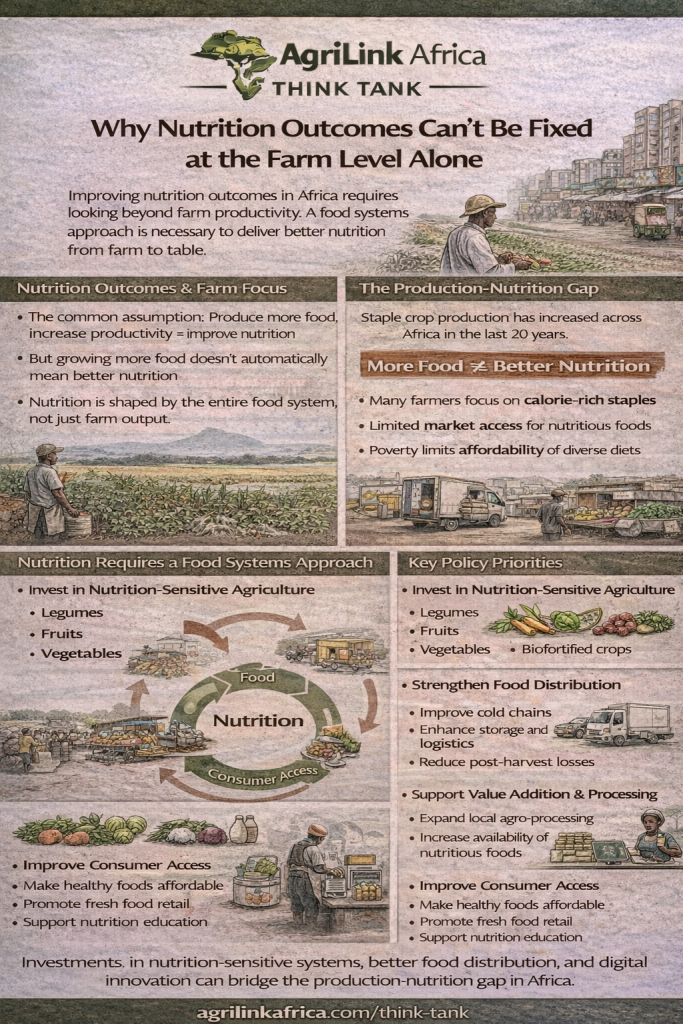
Nutrition outcomes Africa remain one of the most persistent development challenges despite decades of agricultural investment across the continent. Many policies assume that increasing farm production will automatically improve nutrition. The logic appears simple: more food should mean better diets. Yet in reality, the relationship between agriculture and nutrition is far more complex.
Across Africa, food production has grown in several staple crops, but malnutrition remains widespread. Stunting affects millions of children, while micronutrient deficiencies continue to limit human development and productivity. According to the Food and Agriculture Organization, Africa still experiences some of the highest rates of undernourishment globally (FAO, 2023).
The challenge is not only about how food is produced but also how it moves through markets, supply chains, food systems, health services, and household decisions. Improving nutrition outcomes Africa therefore requires a broader approach that goes beyond farm-level interventions.
This article explores why agriculture alone cannot solve nutrition challenges and why policymakers must address the entire food system to achieve meaningful improvements.
Understanding Nutrition Outcomes in Africa
What Do We Mean by Nutrition Outcomes Africa?
Nutrition outcomes typically refer to measurable indicators that reflect the nutritional status of populations. These include:
- Rates of stunting in children
- Micronutrient deficiencies
- Levels of undernourishment
- Diet diversity
- Child and maternal health indicators
While agriculture plays an important role in food availability, nutrition outcomes depend on multiple interconnected systems.
According to the World Bank, improvements in agricultural productivity do not automatically translate into improved nutrition unless complementary policies are implemented across sectors (World Bank, 2022).
Why Agricultural Production Alone Cannot Solve Nutrition Challenges
The Production-Nutrition Disconnect
Many African agricultural strategies prioritize increasing crop yields. However, higher yields do not necessarily lead to improved diets.
Several structural factors explain this disconnect:
1. Market Access Shapes Food Availability
Farmers may produce food but still sell most of it to meet household financial needs. As a result, the food consumed within households may not reflect the diversity of crops produced.
Poor infrastructure also limits food distribution. Rural logistics challenges often prevent nutritious foods from reaching urban markets efficiently. These structural issues are explored further in Why Poor Rural Roads Cost African Farmers More Than Climate Change.
Without functioning food markets and logistics systems, production increases do not automatically improve consumer nutrition.
2. Diet Diversity Is Often Limited
Even when food production increases, diets frequently remain dominated by staple crops.
Common staple foods in many African countries include:
- maize
- rice
- cassava
- sorghum
- millet
While these crops provide calories, they often lack key micronutrients required for healthy development.
According to the Global Nutrition Report, poor diet diversity remains one of the leading drivers of malnutrition worldwide (Global Nutrition Report, 2023).
This highlights why nutrition outcomes Africa cannot be improved solely through higher staple crop production.
3. Post-Harvest Loss Reduces Nutritional Impact
A significant share of food produced in Africa never reaches consumers.
Estimates suggest that 30–40% of food is lost after harvest across developing regions due to storage, transport, and market failures (FAO, 2019).
These losses disproportionately affect:
- fruits
- vegetables
- dairy products
- protein-rich foods
These are precisely the foods that are most important for improving nutrition outcomes.
Logistics and distribution systems therefore play a central role in determining whether nutritious foods reach consumers.
Food Systems Matter More Than Farm Production
Nutrition Outcomes Africa Depend on Entire Food Systems
Food systems include all actors and processes involved in producing, processing, distributing, and consuming food.
This includes:
- farmers
- traders
- processors
- transport networks
- retail markets
- consumer behavior
- health systems
Improving nutrition outcomes Africa requires strengthening each part of this chain.
The systemic nature of food systems is explored in Regional Food Trade in Africa: Policy Vision vs Ground Reality.
When food systems function efficiently, nutritious foods become more accessible and affordable.
Key Barriers Preventing Better Nutrition Outcomes
Infrastructure Constraints
One of the biggest barriers to improved nutrition is inadequate rural infrastructure.
Poor roads increase the cost of transporting perishable foods such as:
- fruits
- vegetables
- dairy
- meat
This often leads to limited availability in both rural and urban markets.
Infrastructure gaps also contribute to food loss and price volatility.
Limited Cold Chain Systems
Cold storage infrastructure remains scarce across much of Africa.
Without refrigeration systems, nutritious foods spoil quickly during transportation.
As a result:
- traders avoid transporting perishables
- consumers face higher prices
- diets remain limited to shelf-stable staples
Cold chain investments can dramatically improve nutrition access by preserving high-value foods.
Income Constraints and Household Choices
Household income also plays a crucial role in nutrition outcomes.
Even when nutritious foods are available, low-income households may prioritize calorie-dense staple foods that provide more energy per dollar.
This highlights the importance of broader economic policies alongside agricultural development.
Why Digital Agriculture Alone Won’t Solve Nutrition Challenges
Digital technologies are often promoted as solutions to agricultural development challenges.
However, adoption barriers remain significant.
Digital advisory tools, market platforms, and farm management apps have potential benefits, but many farmers do not adopt them consistently.
These adoption challenges are explored in Why Farmers Don’t Adopt Digital Tools (Even When They Work).
While digital agriculture can improve productivity and market access, it cannot independently solve nutrition challenges without broader food system reforms.
The Need for Integrated Policy Solutions
A Multi-Sector Strategy for Nutrition Outcomes Africa
Improving nutrition outcomes requires coordinated policies across several sectors.
Key policy priorities include:
1. Strengthening Food Supply Chains
Governments and development partners should invest in:
- rural roads
- logistics networks
- wholesale food markets
- cold storage systems
These investments help ensure nutritious foods reach consumers efficiently.
2. Encouraging Nutrition-Sensitive Agriculture
Agricultural policies should promote diversified production systems that include:
- fruits and vegetables
- legumes
- livestock
- nutrient-dense crops
Diversified farming systems can increase both incomes and nutritional value.
3. Supporting Regional Food Trade
Cross-border food trade can improve food availability and stabilize prices.
However, regulatory barriers often restrict regional food flows.
Addressing these barriers can improve food system resilience and enhance nutrition outcomes.
4. Linking Agriculture with Health and Education
Nutrition outcomes are also shaped by:
- maternal health programs
- school feeding programs
- nutrition education
- sanitation infrastructure
Policies that integrate agriculture with health and education sectors have proven more effective in improving nutrition indicators.
Rethinking Agricultural Success Metrics
Agricultural performance is often measured using yield indicators alone.
However, yield improvements do not necessarily translate into improved livelihoods or nutrition outcomes.
This issue is discussed further in Why Yield Alone Is a Misleading Metric in African Farming.
More comprehensive metrics should consider:
- diet diversity
- food affordability
- food system resilience
- nutritional outcomes
These indicators provide a more accurate picture of food system performance.
The Future of Nutrition Outcomes in Africa
Improving nutrition outcomes Africa will require moving beyond narrow agricultural strategies.
Future food system strategies must address:
- production
- logistics
- markets
- nutrition education
- health services
Policymakers increasingly recognize that agriculture is only one part of a broader food system that determines dietary outcomes.
By strengthening the entire food value chain, African countries can make meaningful progress toward ending malnutrition and improving public health.
FAQs
Why are nutrition outcomes Africa still poor despite agricultural growth?
Nutrition outcomes remain weak because food systems involve more than farm production. Market access, food distribution, income levels, and diet diversity all influence nutritional outcomes across African countries.
Can improving agricultural productivity improve nutrition outcomes Africa?
Higher productivity can help, but only when combined with better food distribution systems, diversified crops, and policies that improve diet diversity and food access.
What policies improve nutrition outcomes Africa the most?
Policies that integrate agriculture with health, infrastructure, logistics, and education tend to produce the strongest improvements in nutrition outcomes across Africa.

Abenezer Wondimagegn is the Founder & CEO of AgriLink Africa, a Research & Data Analyst, and Article Publisher. He specializes in Agriculture, Supply Chain, Logistics, Nutrition, E-commerce, and Business Investment. Through his work, he empowers farmers, strengthens food systems, and shares insights to drive innovation and sustainable growth in Ethiopia’s agricultural sector.

