
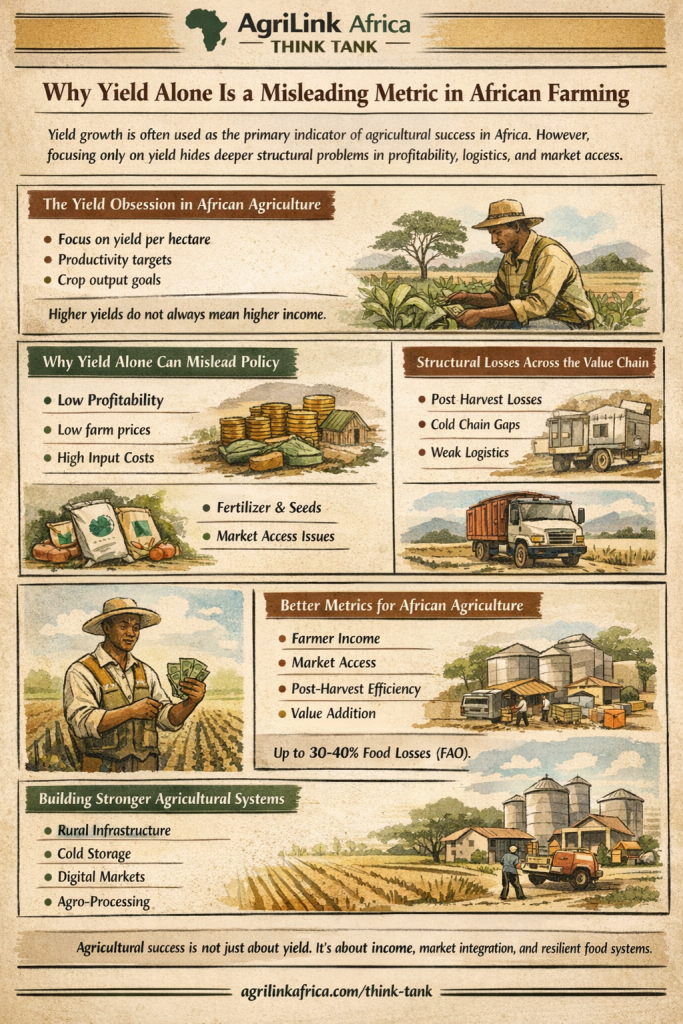
Farming yield metrics Africa have long been used by policymakers, researchers, and development institutions to evaluate agricultural performance across the continent. Yield per hectare is frequently treated as the primary indicator of productivity, policy success, and food system progress.
However, farming yield metrics Africa often provide an incomplete and sometimes misleading picture of agricultural realities. Many agricultural programs, donor projects, and government strategies prioritize increasing crop yields without fully considering profitability, market access, resilience, and logistical constraints.
As a result, farms may achieve higher yields while farmers themselves remain economically vulnerable.
This disconnect reflects a deeper structural challenge in African food systems. Agricultural success cannot be measured solely by production output; it must also account for market integration, value chains, infrastructure, and economic viability.
As explored in Food Security in Africa Is a Market Failure, Not a Production Failure, Africa’s agricultural challenges often stem from market inefficiencies rather than insufficient production.
Understanding why yield alone is an insufficient metric is essential for designing agricultural policies that genuinely improve farmer livelihoods.
The Dominance of Yield in Farming Metrics Africa
Across global agriculture, yield has become the dominant performance indicator. International institutions frequently measure progress using metrics such as:
- Yield per hectare
- Total crop output
- Productivity per unit of land
These indicators are easy to measure and compare across regions, which explains their widespread adoption.
However, in farming yield metrics Africa, yield improvements do not always translate into improved farmer incomes or food system resilience.
For example:
- A farmer may double maize yield but face falling market prices due to oversupply.
- Increased production may lead to post-harvest losses due to poor storage infrastructure.
- Higher yields may require expensive inputs that reduce net profit.
Agricultural productivity must therefore be evaluated through multiple dimensions, not simply output volume.
According to global agricultural assessments, productivity indicators should consider economic, environmental, and social factors rather than yield alone (FAO, 2021).
Why Farming Yield Metrics Africa Can Be Misleading
1. Yield Does Not Measure Farmer Profitability
The most significant limitation of yield-based metrics is that they measure output rather than income.
Farmers ultimately operate within economic systems. What matters is not just how much they produce, but whether they generate sustainable profits.
Consider the following scenario:
A farmer increases maize yield from 2 tons per hectare to 4 tons per hectare.
However:
- Input costs rise due to fertilizers and improved seeds
- Transport costs increase due to poor rural roads
- Market prices fall due to supply spikes
The result may be lower net profit despite higher yield.
This economic reality is discussed in Unit Economics in African Agribusiness: What Most Business Plans Ignore, which shows how agricultural ventures often overlook cost structures when evaluating productivity.
2. Yield Ignores Market Access Constraints
Another major weakness in farming yield metrics Africa is the lack of attention to market access.
Farmers can only benefit from increased production if they are able to sell their crops efficiently.
However, many rural areas face major market barriers:
- Poor rural roads
- Limited storage infrastructure
- Weak market information systems
- Few structured buyers
Without market integration, higher yields may simply increase post-harvest losses.
Globally, up to 14 percent of food is lost before reaching retail markets, often due to logistical constraints (FAO, 2019).
In African rural regions, these losses can be significantly higher.
This is why infrastructure development remains critical, as discussed in Why Poor Rural Roads Cost African Farmers More Than Climate Change.
3. Yield Fails to Capture Risk and Resilience
Agricultural productivity must also be evaluated in terms of risk management and resilience.
A farming system that produces high yields under ideal conditions may be highly vulnerable to:
- drought
- pests and diseases
- market shocks
- input price volatility
Many African farmers intentionally prioritize risk minimization rather than yield maximization.
Common strategies include:
- crop diversification
- staggered planting
- mixed farming systems
These practices may produce lower yields but increase long-term resilience.
The focus on yield alone therefore undervalues strategies that help farmers survive volatile environments.
4. Yield Metrics Ignore Agricultural Value Chains
Agriculture is not only about farm-level production. It also involves complex value chains including processing, logistics, and distribution.
When raw agricultural commodities are exported or sold without processing, farmers capture only a small portion of the total value created.
Examples across Africa include:
- Cocoa exported raw rather than processed chocolate
- Coffee exported unroasted rather than packaged products
- Livestock traded live rather than processed meat
This value chain imbalance significantly reduces the economic impact of agricultural production.
Research in Agricultural Value Chains in Africa highlights how limited agro-processing capacity constrains farmer income growth.
Beyond Yield: Better Metrics for African Agriculture
To understand agricultural performance more accurately, policymakers must adopt multi-dimensional productivity metrics.
Key indicators include:
1. Farmer Income Per Hectare
Income-based metrics measure the actual financial outcome for farmers.
Important indicators include:
- net profit per hectare
- return on agricultural investment
- farm household income
These indicators better reflect economic sustainability.
2. Market Integration Metrics
Agricultural success should also consider how effectively farmers connect to markets.
Relevant indicators include:
- percentage of production sold in formal markets
- access to structured buyers
- transport time to wholesale markets
Strong market integration increases farmer bargaining power.
3. Post-Harvest Efficiency
Reducing food loss can have the same economic impact as increasing yield.
Key measurements include:
- post-harvest loss rates
- storage capacity availability
- cold chain infrastructure coverage
Improving logistics can dramatically increase food system efficiency.
These dynamics are explored further in Agricultural Logistics in Africa.
4. Value Addition Indicators
Agricultural development must also measure how much value is created within domestic supply chains.
Examples include:
- share of crops processed domestically
- agro-processing employment levels
- food manufacturing output
Countries with stronger processing sectors capture far more economic value from agriculture.
The Policy Risks of Over-Reliance on Yield
When policymakers rely exclusively on yield metrics, several unintended consequences may occur.
These include:
- Input-heavy farming models
Programs may prioritize fertilizers and improved seeds without addressing market systems.
- Short-term productivity projects
Development initiatives may focus on quick yield gains rather than long-term system transformation.
- Neglect of infrastructure investment
Critical investments in roads, storage, and logistics may be overlooked.
- Limited attention to farmer profitability
Agricultural success may be measured in tons produced rather than livelihoods improved.
These policy risks highlight the need for system-wide agricultural strategies.
Reframing Agricultural Productivity in Africa
A more realistic framework for evaluating farming yield metrics Africa must consider agriculture as part of a broader food system.
Key pillars include:
- production
- logistics
- market systems
- value chains
- rural infrastructure
Urban demand also plays an increasingly central role in shaping agricultural markets.
As discussed in Urban Food Systems in Africa, cities are becoming the dominant drivers of food demand across the continent.
Agricultural policies must therefore align rural production systems with expanding urban markets.
The Strategic Opportunity for African Agriculture
Africa possesses significant agricultural potential.
The continent holds:
- 60% of the world’s uncultivated arable land
- rapidly expanding food markets
- a growing urban population
However, unlocking this potential requires shifting the focus of agricultural policy from production alone to food system transformation.
Regional integration initiatives such as the African Continental Free Trade Area also create opportunities to expand agricultural markets.
As explored in AfCFTA African Agriculture: Why Trade Liberalization Hasn’t Reached Farmers, trade policy must be aligned with infrastructure and value chain development to benefit farmers.
Conclusion: Measuring What Actually Matters
Yield will remain an important agricultural indicator. However, farming yield metrics Africa cannot serve as the sole measure of agricultural success.
A more comprehensive evaluation framework must incorporate:
- farmer profitability
- market access
- logistics efficiency
- value chain integration
- resilience to shocks
Only by adopting broader productivity metrics can policymakers design agricultural strategies that genuinely improve farmer livelihoods.
African agriculture does not merely need higher yields. It requires stronger food systems capable of transforming production into sustainable economic growth.
FAQs
What are farming yield metrics Africa?
Farming yield metrics Africa refer to indicators used to measure agricultural productivity across African farming systems, typically expressed as crop output per hectare.
Why are farming yield metrics Africa sometimes misleading?
Farming yield metrics Africa can be misleading because they measure production output but ignore farmer profitability, market access, post-harvest losses, and value chain integration.
What indicators should replace farming yield metrics Africa?
Better indicators include farmer income per hectare, market integration rates, post-harvest loss reduction, and value addition through agro-processing industries.

Abenezer Wondimagegn is the Founder & CEO of AgriLink Africa, a Research & Data Analyst, and Article Publisher. He specializes in Agriculture, Supply Chain, Logistics, Nutrition, E-commerce, and Business Investment. Through his work, he empowers farmers, strengthens food systems, and shares insights to drive innovation and sustainable growth in Ethiopia’s agricultural sector.

