
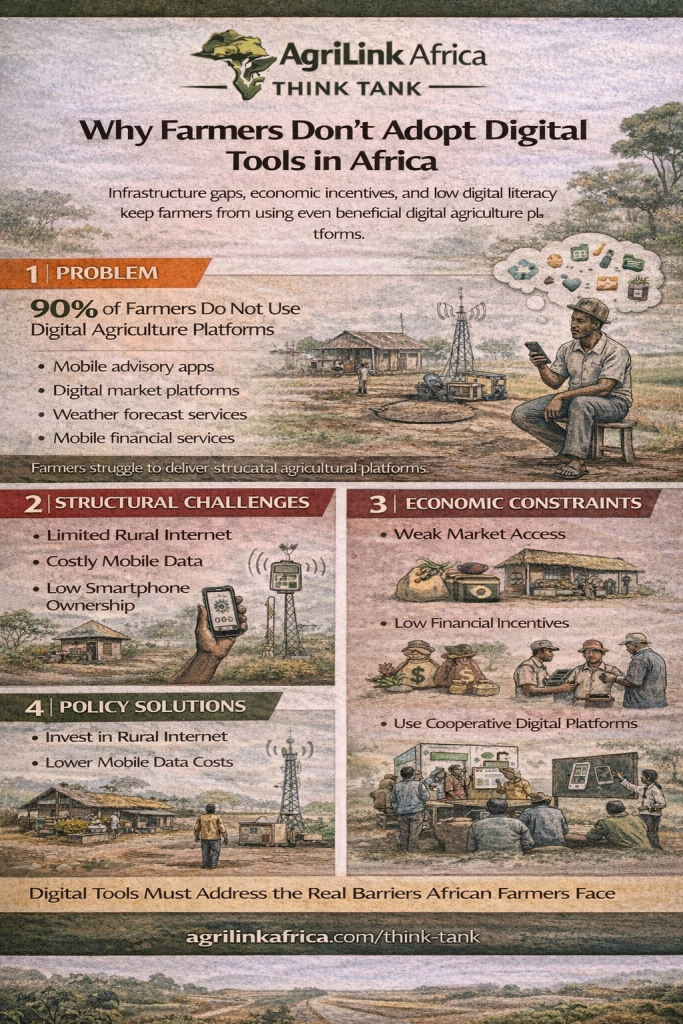
Digital Tool Adoption Farmers Africa: Understanding the Real Barriers
Digital tool adoption farmers Africa remains one of the most debated topics in agricultural modernization. Across the continent, governments, development agencies, and technology companies have launched thousands of digital agriculture platforms designed to improve productivity, market access, and financial inclusion.
These tools promise to deliver:
- Weather forecasts for farmers
- Mobile-based advisory services
- Market price information
- Digital credit and insurance
- Supply chain transparency
Yet despite the clear potential, most African farmers still do not consistently use these digital tools.
This raises an important question for policymakers and agricultural system designers:
Why do farmers avoid tools that appear beneficial?
The answer lies not in the technology itself but in the structural realities of African agricultural systems.
As explored in the AgriLink Think Tank pillar article on digital transformation in agriculture, Digital Agriculture in Africa: Promise vs Reality, adoption challenges are deeply connected to infrastructure, trust, economics, and institutional design.
Understanding these barriers is essential for designing digital agriculture policies that actually work.
The Promise of Digital Agriculture in Africa
Digital tools have the potential to transform African food systems. Mobile connectivity has expanded rapidly across the continent, creating opportunities to connect farmers with information and markets.
Some widely promoted digital agriculture tools include:
- Mobile advisory platforms
- Digital farm management tools
- Satellite-based crop monitoring
- Mobile marketplaces for farm products
- Digital financial services for agriculture
According to the Food and Agriculture Organization, digital technologies can significantly improve farm productivity and resilience when properly integrated into agricultural systems (FAO, 2021).
However, the gap between technological innovation and real farmer adoption remains large.
Structural Barriers to Digital Tool Adoption Farmers Africa
1. Infrastructure Constraints
The first barrier to digital tool adoption farmers Africa is infrastructure.
Many digital agriculture platforms assume farmers have reliable access to:
- Internet connectivity
- Smartphones
- Electricity for charging devices
- Affordable mobile data
In reality, rural infrastructure gaps remain significant across Africa.
Poor infrastructure affects not only digital tools but also broader agricultural performance, as discussed in Why Poor Rural Roads Cost African Farmers More Than Climate Change.
Key infrastructure challenges include:
- Limited rural internet coverage
- High data costs
- Frequent power outages
- Low smartphone ownership
Without solving these foundational issues, digital agriculture initiatives often struggle to reach the farmers who need them most.
2. Economic Incentives Are Often Weak
Farmers adopt innovations when they see clear economic benefits.
However, many digital agriculture tools provide information but not income.
For example, a farmer receiving SMS weather forecasts may still face:
- Lack of irrigation
- Poor seed access
- Limited markets
- High transport costs
Information alone does not solve structural agricultural constraints.
Research from the World Bank shows that farmers prioritize technologies that directly increase income or reduce risk (World Bank, 2022).
This means digital tools must be integrated with real economic opportunities, not just advisory services.
3. Trust Deficit in Digital Platforms
Another major challenge affecting digital tool adoption farmers Africa is trust.
Many farmers remain skeptical about digital platforms for several reasons:
- Previous failed development projects
- Limited understanding of digital systems
- Fear of scams or misinformation
- Lack of local support when problems occur
In many rural areas, farmers trust:
- Local extension agents
- Farmer cooperatives
- Traders and community networks
Digital tools that ignore these social systems often fail to gain traction.
Successful platforms typically integrate digital services with existing agricultural institutions, including cooperatives and extension systems.
Behavioral and Social Barriers to Digital Adoption
Technology Design Often Ignores Farmer Realities
Many digital agriculture tools are designed by engineers and developers who have limited experience with smallholder farming.
This leads to platforms that:
- Require complex interfaces
- Use technical language
- Depend heavily on smartphones
- Assume high digital literacy
However, many African farmers operate in environments where:
- Literacy levels vary
- Smartphone penetration is uneven
- Internet access is limited
As a result, simple technologies like SMS-based systems or voice services often outperform advanced mobile apps.
Digital Solutions Must Fit Farming Systems
Another issue affecting digital tool adoption farmers Africa is that many tools focus on single problems rather than integrated farming systems.
Farmers make decisions based on multiple factors:
- Weather conditions
- Market demand
- Labor availability
- Input costs
- Risk management
Digital tools that only address one aspect—such as weather information—may not provide sufficient value.
System-level platforms that integrate advisory, markets, finance, and logistics tend to achieve higher adoption rates.
Market Access Remains a Bigger Constraint Than Information
Many digital agriculture initiatives focus heavily on information services.
However, African farmers often face a more pressing challenge: market access.
Even when farmers receive better production advice, they may still struggle to sell their crops profitably.
This is why agricultural value chain development is essential for digital adoption.
The AgriLink Think Tank analysis in Why Most African Agricultural Value Chains Destroy Value Instead of Creating It highlights how weak market structures limit farmer profitability.
Key market constraints include:
- Fragmented supply chains
- Limited aggregation systems
- Lack of cold storage
- Poor logistics networks
Digital tools that connect farmers directly to markets are more likely to succeed.
Lessons from Successful Digital Agriculture Models
Despite the challenges, several digital agriculture initiatives in Africa have achieved meaningful adoption.
These successful models share several characteristics.
1. Farmer-Centered Design
Successful platforms are built around farmer needs rather than technological possibilities.
Key design principles include:
- Simple user interfaces
- Local languages
- Voice-based systems
- Offline functionality
2. Integration with Existing Institutions
Digital platforms that collaborate with:
- Cooperatives
- Agricultural extension systems
- Input suppliers
- Market buyers
are more likely to gain farmer trust.
3. Clear Economic Benefits
Farmers adopt technologies when they:
- Increase income
- Reduce risk
- Improve market access
For example, digital marketplace platforms that connect farmers to buyers can significantly increase farm gate prices.
This is particularly important in the context of regional trade integration, as explored in AfCFTA and Agriculture: Why Trade Liberalization Hasn’t Reached Farmers.
Policy Priorities for Accelerating Digital Tool Adoption Farmers Africa
For policymakers seeking to scale digital agriculture, the focus should shift from technology deployment to system transformation.
Key policy priorities include:
1. Invest in Rural Digital Infrastructure
Governments must expand:
- Rural broadband access
- Mobile network coverage
- Electricity infrastructure
These investments are fundamental to digital agriculture.
2. Strengthen Agricultural Extension Systems
Extension services remain critical for translating digital tools into real farm-level impact.
Digital platforms should complement—not replace—human advisory systems.
3. Promote Integrated Digital Ecosystems
Instead of isolated apps, policymakers should encourage digital ecosystems that integrate:
- Market access platforms
- Financial services
- Supply chain logistics
- Agricultural advisory systems
4. Support Digital Literacy for Farmers
Digital literacy programs can significantly improve adoption rates.
Training initiatives should focus on:
- Mobile phone use
- Digital financial services
- Agricultural information platforms
The Future of Digital Tool Adoption Farmers Africa
Digital agriculture remains one of the most promising pathways for transforming African food systems.
However, technology alone cannot solve structural agricultural challenges.
Successful digital transformation requires a systems approach that combines:
- Infrastructure development
- Institutional reform
- Market access expansion
- Farmer-centered innovation
When these conditions are aligned, digital tools can significantly improve productivity, resilience, and income for millions of African farmers.
Without addressing these systemic barriers, however, many digital agriculture initiatives will continue to struggle with adoption.
FAQs
Why is digital tool adoption farmers Africa still low?
Digital tool adoption farmers Africa remains low due to infrastructure gaps, weak economic incentives, low digital literacy, and limited trust in digital platforms among smallholder farmers.
What types of digital tools are used in African agriculture?
Common digital agriculture tools include mobile advisory services, digital marketplaces, weather forecasting platforms, satellite-based monitoring, and mobile financial services designed for farmers.
How can policymakers improve digital tool adoption farmers Africa?
Policymakers can improve digital tool adoption farmers Africa by investing in rural internet infrastructure, strengthening extension systems, supporting farmer digital literacy, and integrating digital platforms with agricultural markets.

Abenezer Wondimagegn is the Founder & CEO of AgriLink Africa, a Research & Data Analyst, and Article Publisher. He specializes in Agriculture, Supply Chain, Logistics, Nutrition, E-commerce, and Business Investment. Through his work, he empowers farmers, strengthens food systems, and shares insights to drive innovation and sustainable growth in Ethiopia’s agricultural sector.

