
Rural infrastructure African agriculture is one of the most overlooked yet decisive factors shaping the economic future of African food systems. While climate change often dominates agricultural policy discussions, millions of African farmers face a more immediate and persistent barrier: poor rural roads.
Across much of the continent, weak rural infrastructure increases transportation costs, limits access to markets, accelerates post-harvest losses, and discourages investment in agricultural production. For many smallholder farmers, the inability to move crops efficiently from farm to market represents a larger economic constraint than rainfall variability or temperature fluctuations.
As examined in Agricultural Logistics in Africa, weak transport systems remain one of the central structural bottlenecks preventing African agriculture from becoming a competitive and integrated sector.
The implications extend far beyond logistics. Poor rural roads affect agricultural productivity, rural incomes, food prices, and regional trade flows—making rural infrastructure one of the most critical yet under-prioritized policy areas in African agriculture.
The Scale of Rural Infrastructure Challenges in African Agriculture
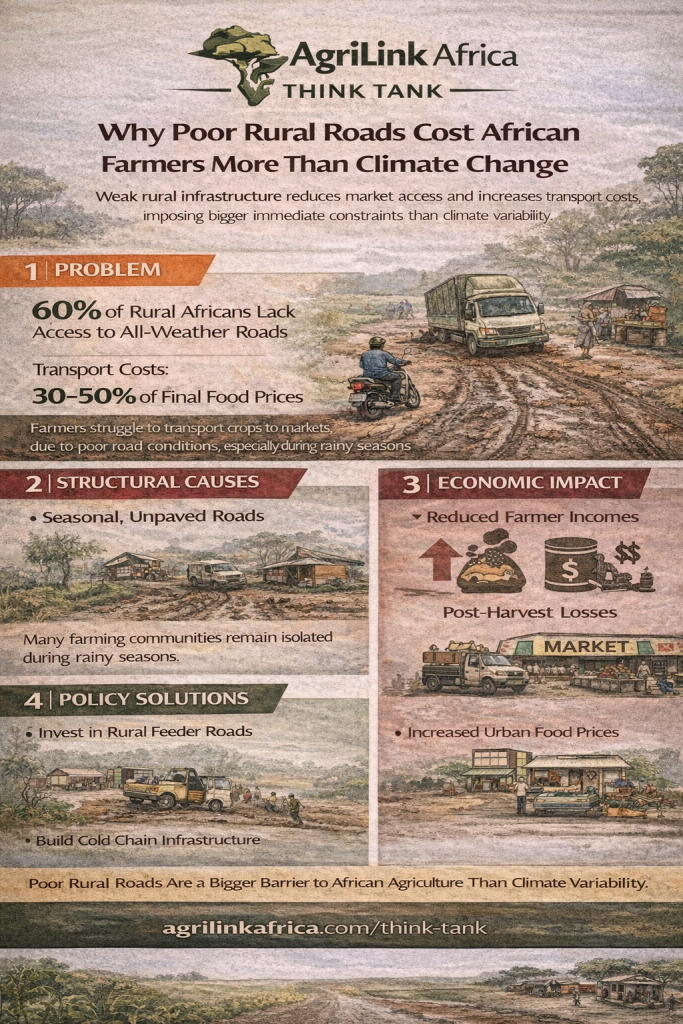
Rural infrastructure African agriculture systems remain significantly underdeveloped compared to other regions.
Across Africa:
- Nearly 60% of rural Africans lack reliable access to all-season roads World Bank, 2022.
- Many farming communities remain isolated during rainy seasons.
- Transport costs often represent 30–50% of the final food price in some African markets World Bank, 2020.
These figures illustrate a core paradox: Africa produces substantial agricultural output, yet inefficient rural transport networks prevent that food from reaching markets efficiently.
This structural problem also connects to broader food system inefficiencies discussed in Food Security in Africa Is a Market Failure, Not a Production Failure.
The issue is therefore not simply agricultural productivity—it is the ability to move food through the economic system.
How Poor Rural Roads Increase Costs for Farmers
1. Higher Transport Costs
Poor road conditions significantly increase the cost of moving agricultural goods.
Transporters often face:
- Longer travel times
- Higher fuel consumption
- Frequent vehicle maintenance
- Limited vehicle access during rainy seasons
As a result, transport costs per kilometer in many African rural corridors can be two to three times higher than global averages World Bank, 2020.
These costs are usually transferred directly to farmers through lower farm-gate prices.
2. Limited Market Access
Weak rural roads reduce the number of markets farmers can access.
Instead of reaching multiple buyers, farmers often depend on a single local trader who controls prices.
Typical consequences include:
- Reduced bargaining power
- Lower price transparency
- Limited competition among buyers
This dynamic reinforces market inefficiencies described in Unit Economics in African Agribusiness.
3. Increased Post-Harvest Losses
Perishable commodities such as fruits, vegetables, dairy, and fish are particularly vulnerable to poor transport infrastructure.
Slow transport and lack of cold chain systems lead to substantial post-harvest losses.
Across Africa:
- Post-harvest losses can reach 30–40% for some perishable crops FAO, 2021.
This means a significant portion of agricultural production never reaches consumers.
The economic implications are enormous: farmers lose income while urban food prices remain high.
Why Rural Infrastructure Often Matters More Than Climate Change
Climate change certainly affects agricultural systems through droughts, floods, and shifting weather patterns.
However, for many farmers the most immediate economic constraint is market connectivity.
Consider two hypothetical farmers:
Farmer A
- Faces moderate climate variability
- Has access to paved roads and regional markets
Farmer B
- Experiences similar weather conditions
- Lives in a village connected by seasonal dirt roads
Even if both farmers produce similar yields, Farmer B will likely earn significantly lower income due to higher transaction costs and reduced market access.
In this context, rural infrastructure becomes a key determinant of economic opportunity.
The Role of Rural Roads in Agricultural Value Chains
Agricultural value chains depend on efficient movement between multiple actors:
- Farmers
- Aggregators
- Processors
- Wholesalers
- Retailers
Poor rural roads disrupt this chain at the earliest stage.
Weak infrastructure discourages private investment in:
- Agro-processing facilities
- Cold storage systems
- Rural aggregation hubs
As discussed in Agricultural Value Chains in Africa, value creation in agriculture depends heavily on efficient logistics and supply chain coordination.
Without reliable rural transport networks, many agricultural regions remain disconnected from broader economic systems.
Rural Infrastructure and Regional Food Trade
Poor rural roads also affect cross-border agricultural trade.
Regional trade agreements such as AfCFTA aim to increase intra-African agricultural trade, yet rural infrastructure remains a major constraint.
Many agricultural commodities must first travel from rural production zones to urban or border markets before entering regional trade flows.
As examined in Regional Food Trade in Africa: Policy Vision vs Ground Reality, weak domestic logistics networks often undermine the potential benefits of continental trade integration.
Without improvements in rural infrastructure, many farmers will remain excluded from regional markets.
Policy Priorities for Rural Infrastructure African Agriculture
Addressing rural infrastructure constraints requires coordinated policy action across multiple sectors.
1. Expand Rural Road Networks
Governments should prioritize:
- All-weather rural feeder roads
- Maintenance programs for existing roads
- Rural transport corridors linking farms to markets
Infrastructure investments can significantly reduce agricultural transaction costs.
2. Integrate Infrastructure with Agricultural Policy
Rural infrastructure should be integrated into broader agricultural development strategies.
This includes:
- Linking road development with agricultural clusters
- Supporting agro-processing zones near production areas
- Coordinating transport investments with market infrastructure
These integrated approaches are essential for broader food system transformation, as highlighted in Food Systems Transformation in Africa.
3. Encourage Private Sector Logistics
Private sector participation in rural logistics can help expand transport services.
Examples include:
- Rural transport cooperatives
- Digital freight platforms
- Agricultural logistics startups
Such innovations can complement public infrastructure investments.
Economic Returns from Rural Infrastructure Investment
Investments in rural roads often generate strong economic returns.
Research indicates that improved rural transport infrastructure can lead to:
- Higher agricultural productivity
- Lower food prices
- Increased rural employment
- Expanded regional trade
In some cases, road investments generate returns exceeding many agricultural subsidy programs.
Better rural roads allow farmers to diversify crops, access input markets, and participate in regional supply chains.
Conclusion: Rural Infrastructure as the Foundation of African Agricultural Growth
Rural infrastructure African agriculture systems represent one of the most critical yet under-invested components of the continent’s food economy.
While climate change adaptation remains important, the economic constraints created by poor rural roads often impose greater immediate costs on farmers.
Improving rural transport infrastructure can unlock multiple development benefits:
- Higher farmer incomes
- Lower consumer food prices
- Reduced post-harvest losses
- Stronger agricultural value chains
- Expanded regional trade
Ultimately, transforming African agriculture requires not only better seeds, technologies, or policies—but also the physical infrastructure that allows food to move efficiently through markets.
For millions of farmers across the continent, the road to agricultural prosperity is quite literally a road.
Frequently Asked Questions (FAQs)
What is rural infrastructure African agriculture?
Rural infrastructure African agriculture refers to the physical systems—especially rural roads, transport networks, storage facilities, and logistics infrastructure—that enable agricultural production and market access across rural areas.
Why is rural infrastructure important for African farmers?
Rural infrastructure is essential because it reduces transportation costs, improves access to markets, decreases post-harvest losses, and increases farmer incomes by connecting rural production areas to urban food markets.
How can rural infrastructure improve African agriculture?
Improving rural infrastructure African agriculture systems through better roads, logistics networks, and market connectivity allows farmers to access regional markets, attract investment, and participate more effectively in agricultural value chains.

Abenezer Wondimagegn is the Founder & CEO of AgriLink Africa, a Research & Data Analyst, and Article Publisher. He specializes in Agriculture, Supply Chain, Logistics, Nutrition, E-commerce, and Business Investment. Through his work, he empowers farmers, strengthens food systems, and shares insights to drive innovation and sustainable growth in Ethiopia’s agricultural sector.

