
Africa is urbanizing faster than any other region in the world. By 2035, more Africans will live in cities than in rural areas. This demographic shift is transforming labor markets, housing, mobility—and quietly, but profoundly, what people eat.
Urban food environments across Africa are changing rapidly. Traditional diets based on fresh, minimally processed foods are being replaced by highly processed, calorie-dense, nutrient-poor products. The result is a growing public health challenge that food availability metrics alone fail to capture.
This article examines how urbanization is reshaping diets in Africa, why processed foods are displacing fresh alternatives, the economic drivers behind this transition, its long-term health implications, and the market and policy interventions required to reverse current trajectories.
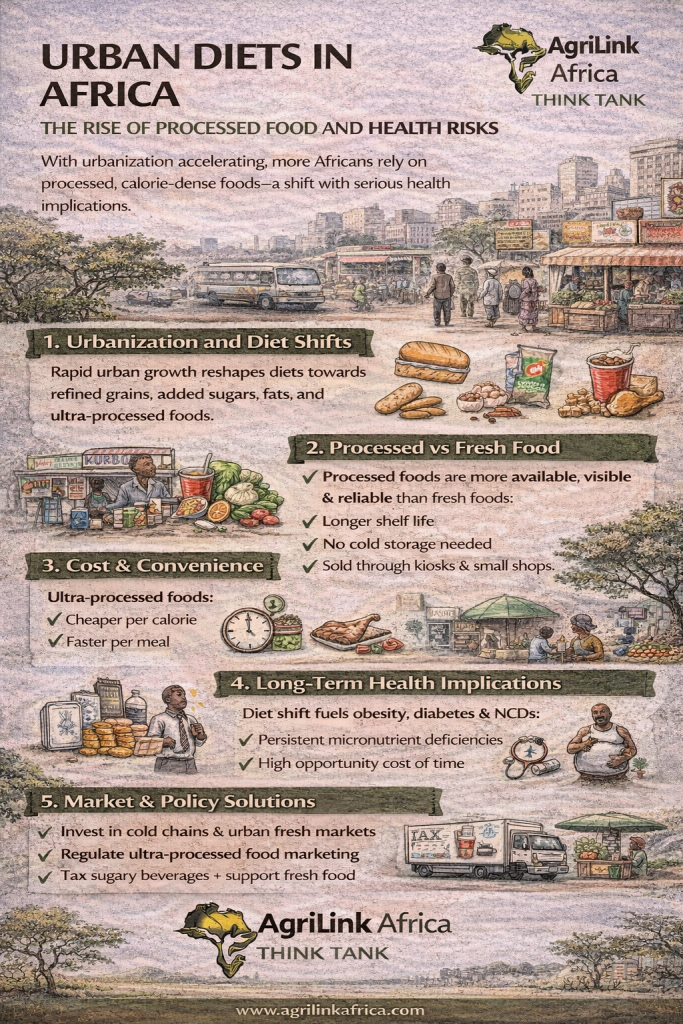
Urbanization and Diet Shifts
Urbanization alters diets through changes in income patterns, time constraints, and food access. Urban households typically consume more purchased food and rely less on own-production. This increases dependence on markets and food retail systems.
According to the Food and Agriculture Organization, urban diets in Africa are increasingly characterized by higher intake of refined grains, added sugars, fats, and ultra-processed foods, alongside declining consumption of legumes, fruits, and vegetables FAO, 2022.
These dietary shifts are not merely cultural. They reflect structural transformations in food systems, retail formats, and supply chains responding to urban demand.
Processed vs Fresh Food Access
In many African cities, processed foods are more available, visible, and reliable than fresh foods.
- Processed foods benefit from longer shelf life
- They require no cold storage
- They are easily distributed through informal kiosks and small shops
Fresh foods—especially fruits, vegetables, dairy, and animal-source proteins—are often constrained by:
- weak cold chains
- high post-harvest losses
- fragmented wholesale markets
- price volatility
The World Bank notes that inadequate urban food logistics and cold storage disproportionately disadvantage fresh and nutritious foods, especially for low-income consumers (World Bank, 2021.
As a result, food choice is shaped less by preference and more by availability and reliability.
Cost and Convenience as Key Drivers
Processed foods are not only more visible—they are often cheaper per calorie and more convenient per unit of time.
Urban households face:
- longer working hours
- informal employment schedules
- limited cooking facilities
- high opportunity cost of time
Ultra-processed foods offer:
- low upfront prices
- minimal preparation time
- predictable taste and quality
Research published in The Lancet Global Health shows that in low- and middle-income countries, including African cities, processed foods increasingly dominate diets among lower-income urban populations due to affordability and convenience (Lancet Global Health, 2019).
👉 https://www.thelancet.com/journals/langlo/article/PIIS2214-109X(19)30065-1/fulltext
This dynamic makes diet quality a structural issue, not a behavioral one.
Long-Term Health Implications
The rise of processed food consumption is closely linked to the rapid increase of non-communicable diseases (NCDs) across urban Africa.
These include:
- obesity
- type 2 diabetes
- hypertension
- cardiovascular disease
The World Health Organization reports that obesity rates in Africa have nearly tripled since 1975, with the fastest growth occurring in urban areas (WHO, 2022).
👉 https://www.who.int/news-room/fact-sheets/detail/obesity-and-overweight
Critically, Africa now faces a double burden of malnutrition:
- undernutrition and micronutrient deficiencies persist
- overnutrition and diet-related NCDs are rising
This combination places severe strain on health systems and reduces long-term labor productivity.
Market and Policy Interventions
Reversing unhealthy urban diet trends requires coordinated action across markets, infrastructure, and policy—not public awareness campaigns alone.
Market-Level Interventions
- Investment in cold chains and urban food logistics
- Support for fresh food wholesale and retail markets
- Incentives for private sector distribution of nutritious foods
- Digital platforms linking producers to urban consumers
Policy-Level Interventions
- Urban food planning integrated into city development strategies
- Nutrition-sensitive agricultural and trade policies
- Regulation of ultra-processed food marketing, especially to children
- Fiscal tools such as sugar-sweetened beverage taxes
The African Union’s nutrition frameworks emphasize the need for food system transformation that explicitly addresses urban consumption patterns (African Union, 2020).
👉 https://au.int/en/documents/20200128/african-nutrition-strategy-2015-2025
Conclusion
Urban diets in Africa are changing faster than policy responses. The rise of processed foods is not simply a lifestyle choice—it is the outcome of how urban food systems are structured.
Without intervention, current trends will deepen health inequities, strain public health systems, and undermine economic productivity.
The path forward is clear:
- Treat urban nutrition as a food system design challenge
- Align markets, infrastructure, and policy toward healthy diets
- Ensure that convenience and affordability do not come at the cost of long-term health
Urban Africa’s food future will shape the continent’s human capital.
Getting diets right is no longer optional—it is strategic.
AgriLink Africa Think Tank
Where African Agricultural Intelligence Is Written

Abenezer Wondimagegn is the Founder & CEO of AgriLink Africa, a Research & Data Analyst, and Article Publisher. He specializes in Agriculture, Supply Chain, Logistics, Nutrition, E-commerce, and Business Investment. Through his work, he empowers farmers, strengthens food systems, and shares insights to drive innovation and sustainable growth in Ethiopia’s agricultural sector.

