
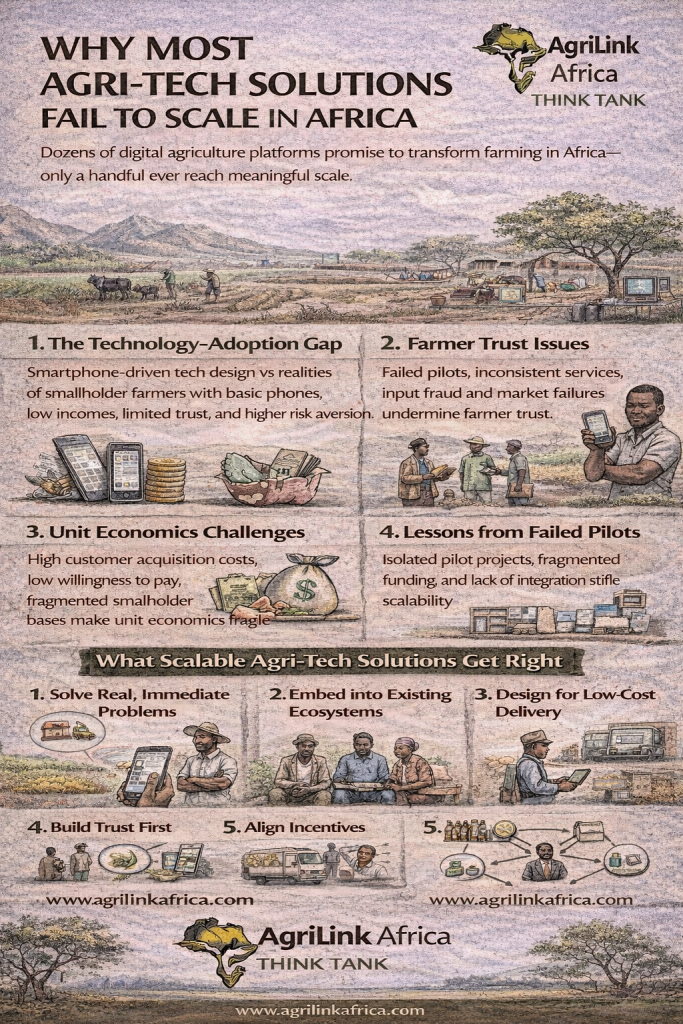
Agri-tech solutions in Africa have multiplied rapidly over the past decade, yet only a small number succeed in scaling beyond pilot projects and donor-funded trials.
Over the past decade, Africa has seen an explosion of agri-tech innovation. Digital platforms promise to transform farming through mobile advisory services, digital marketplaces, satellite data, and AI-driven insights. Pilot projects proliferate. Funding announcements make headlines.
Yet only a small fraction of agri-tech solutions achieve meaningful scale.
The failure is often misdiagnosed as a shortage of technology or capital. In reality, the problem is structural. Most agri-tech solutions struggle not because they are technologically weak, but because they fail to align with farmer realities, unit economics, and food system constraints.
This article examines why agri-tech solutions fail to scale in Africa—and what scalable solutions do differently.
The Technology–Adoption Gap
Africa does not suffer from a lack of agricultural technology. It suffers from a gap between technology design and user adoption.
Many agri-tech tools assume:
- consistent smartphone access
- digital literacy
- stable connectivity
- disposable income for subscriptions
In practice, most smallholder farmers operate under:
- low and irregular incomes
- shared or basic mobile phones
- limited trust in digital services
- high risk aversion
The World Bank notes that while digital agriculture tools show promise, adoption remains limited where solutions are not embedded within existing agricultural workflows and support systems World Bank, 2021.
Technology alone does not change behavior. Trust, relevance, and integration do.
Farmer Trust and Behavioral Constraints
Trust is one of the most underestimated barriers to agri-tech scaling.
Smallholder farmers have experienced decades of:
- failed projects
- inconsistent extension services
- input fraud
- broken market promises
As a result, skepticism toward new platforms is rational, not cultural.
Research by the International Food Policy Research Institute shows that farmers are significantly more likely to adopt new technologies when they are introduced through trusted intermediaries—such as cooperatives, extension agents, or peer farmers—rather than directly by private startups IFPRI, 2020.
Agri-tech solutions that bypass trust networks often fail to move beyond pilot phases.
Unit Economics Challenges
Many agri-tech business models are economically fragile.
Common problems include:
- high customer acquisition costs
- low willingness or ability to pay
- fragmented farmer bases
- expensive last-mile service delivery
A platform may work at pilot scale with donor support, but collapse when required to sustain operations commercially.
CGIAR research highlights that most digital agriculture startups underestimate the cost of servicing smallholders at scale, particularly in dispersed rural settings CGIAR, 2019.
Without viable unit economics, scale becomes dependent on continuous grants rather than sustainable revenue.
Lessons from Failed Pilots
Africa is littered with agri-tech pilots that demonstrated technical success but failed to scale.
Common patterns include:
- solutions designed in isolation from farmers
- pilots optimized for reporting, not replication
- lack of integration with input suppliers, finance, and markets
- dependence on short-term project funding
The Food and Agriculture Organization warns that pilot-driven innovation without system integration often leads to fragmentation rather than transformation FAO, 2022.
Pilots test ideas. Systems create scale.
What Scalable Agri-Tech Solutions Get Right
Agri-tech solutions that scale in Africa share several core characteristics.
1. They Solve Real, Immediate Problems
Scalable solutions address pressing farmer pain points:
- access to inputs
- access to markets
- price transparency
- risk reduction
Technology is a means, not the product.
2. They Embed into Existing Ecosystems
Successful platforms integrate with:
- cooperatives
- agro-dealers
- extension services
- financial institutions
They complement systems instead of replacing them.
3. They Design for Low-Cost Delivery
Scalable models minimize:
- manual intervention
- expensive last-mile operations
- dependence on continuous subsidies
Automation and partnerships replace heavy field operations.
4. They Build Trust First
Trust is built through:
- consistent delivery
- local presence
- peer validation
- transparent pricing
Adoption follows credibility, not marketing.
5. They Align Incentives Across the Value Chain
Platforms that link farmers, buyers, financiers, and logistics providers create network effects that reinforce adoption and retention.
Conclusion
Most agri-tech solutions fail to scale in Africa not because farmers resist innovation, but because systems resist fragmentation.
Technology that ignores economics, trust, and institutional realities remains stuck at pilot stage. Technology that aligns with how African agriculture actually functions has the potential to transform productivity, resilience, and market access.
The path forward is clear:
- shift from tool-centric to system-centric design
- prioritize adoption over features
- build sustainable unit economics
- embed technology within real agricultural ecosystems
Agri-tech will not scale by disrupting farmers.
It will scale by working with them.
AgriLink Africa Think Tank
Where African Agricultural Intelligence Is Written

Abenezer Wondimagegn is the Founder & CEO of AgriLink Africa, a Research & Data Analyst, and Article Publisher. He specializes in Agriculture, Supply Chain, Logistics, Nutrition, E-commerce, and Business Investment. Through his work, he empowers farmers, strengthens food systems, and shares insights to drive innovation and sustainable growth in Ethiopia’s agricultural sector.

