
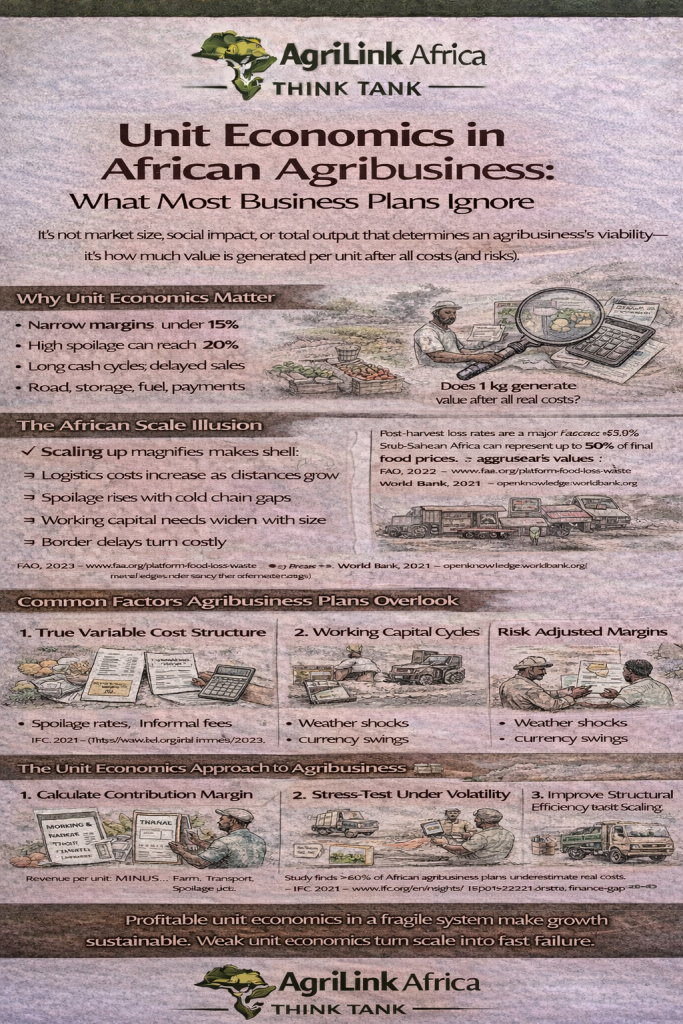
Unit economics in African agribusiness is one of the most overlooked determinants of whether agricultural enterprises can scale successfully. Across Africa, many agribusiness plans emphasize production volumes, farmer numbers, or market demand, yet they fail to analyze the real profitability of each unit sold. Without strong unit economics, scaling operations often magnifies losses rather than generating sustainable growth.
Across Africa, agribusiness proposals frequently emphasize market size, social impact, and production capacity.
They project hectares cultivated, tons processed, or farmers onboarded.
But one critical dimension is often missing:
Unit economics.
Without strong unit economics, scale magnifies losses instead of profits. These structural profitability constraints are deeply embedded in Africa’s agri-commerce ecosystems, where logistics, coordination, and risk allocation shape enterprise outcomes. And in African agriculture—where margins are thin, logistics are costly, and volatility is high—ignoring unit-level profitability can be fatal.
This is why many agribusiness ventures fail not because demand is absent, but because their cost structure per unit is structurally unsustainable.
What Are Unit Economics — and Why They Matter
Unit economics refer to the direct revenues and costs associated with a single unit of product or service.
In agribusiness, a “unit” could mean:
- One kilogram of maize
- One crate of tomatoes
- One liter of milk
- One aggregated ton of grain
- One farmer serviced per season
The economics of aggregation significantly influence unit-level profitability.
At its core, unit economics answers one question:
Does each unit generate positive contribution margin after variable costs?
If not, scaling production or market reach will increase losses.
In African agribusiness, this question is particularly critical because:
- Logistics costs are disproportionately high
- Post-harvest losses reduce sellable output
- Working capital cycles are long
- Price volatility and unpredictable price formation compress margins.
According to the Food and Agriculture Organization FAO, 2023, post-harvest losses in Sub-Saharan Africa range between 14–30% depending on commodity and value chain inefficiencies.
Losses at that level directly distort unit profitability calculations.
The Scale Illusion in African Agribusiness
Many business plans assume that scale automatically reduces cost per unit.
This assumption often fails in African food systems.
Why?
Because infrastructure constraints create diseconomies of scale beyond certain thresholds:
- Longer transport distances increase fuel exposure
- Cold chain gaps increase spoilage
- Market fragmentation increases transaction costs
- Border delays disrupt regional trade
These fragmentation dynamics are closely tied to how agricultural intermediation is structured.
Research from the World Bank 2021 shows that transport costs in parts of Sub-Saharan Africa can represent up to 50% of the final food price in remote corridor.
If transport alone consumes half of retail value, the margin available for aggregation, storage, finance, and profit becomes extremely thin.
Scaling volume without redesigning logistics can therefore increase operational losses.
What Most Business Plans Overlook
1. True Variable Cost Structure
Many agribusiness projections underestimate:
- Spoilage rates
- Informal payments
- Fuel volatility
- Packaging losses
- Inventory shrinkage
The result is overly optimistic gross margin assumptions.
A study by the International Finance Corporation IFC, 2021 highlights that inaccurate cost estimation is one of the primary reasons agribusiness SMEs struggle after initial funding rounds.
2. Working Capital Cycles
Agriculture is seasonal. Cash is not.
Businesses often pay farmers upfront but receive payment from buyers weeks later.
This creates negative cash conversion cycles.
Without proper modeling, unit profitability appears positive on paper but collapses under liquidity pressure.
The African Development Bank AfDB, 2019 notes that working capital gaps are a major constraint to agribusiness growth across the continent.
3. Risk-Adjusted Margins
Most projections ignore risk-adjusted pricing.
Agricultural markets face:
- Weather shocks
- Border closures
- Export bans
- Currency depreciation
During 2020–2022, global commodity volatility significantly impacted domestic price transmission across Africa FAO, 2022.
If unit margins are only profitable under ideal price conditions, the business is structurally fragile.
Policy and System-Level Constraints Affect Unit Economics
Unit economics do not exist in isolation.
They are shaped by structural factors:
- Infrastructure quality
- Market transparency
- Financial sector depth
- Trade facilitation
- Regulatory consistency
For example:
- Weak warehouse receipt systems increase storage risk.
- Poor grading standards reduce price differentiation.
- Informal markets reduce enforceability of contracts.
According to research published in the Journal of Agribusiness in Developing and Emerging Economies, 2020, value chain coordination significantly improves margin stability in emerging agricultural markets
This indicates that improving system architecture directly improves unit-level profitability.
Reframing Agribusiness Planning: A Unit-First Approach
Instead of starting with total market size, African agribusiness planning should begin with:
Step 1: Calculate Real Contribution Margin
Revenue per unit
Minus:
- Farm-gate cost
- Aggregation cost
- Transport
- Storage
- Finance cost
- Expected loss rate
If margin is negative, scale is not the solution — redesign is.
Step 2: Stress-Test Under Volatility
Model:
- 10–20% price drop
- 15% fuel increase
- 20% spoilage spike
If unit economics fail under moderate stress, the business is vulnerable.
Step 3: Improve Structural Efficiency Before Scaling
This may include:
- Route optimization
- Digital transaction records
- Cold chain integration
- Contract farming agreements
- Aggregation hubs
Unit economics improve when systems improve.
Why This Matters for Investors and Policymakers
Investors increasingly demand pathways to profitability, not just social impact narratives.
Without credible unit economics:
- Lending risk rises
- Equity valuations collapse
- Follow-on funding dries up
Policymakers should also recognize:
Supporting infrastructure and market reform can do more to strengthen agribusiness viability than subsidizing inputs alone.
Strong unit economics create:
- Strong unit economics create bankable SMEs
- Sustainable employment
- Stable food supply chains
- Resilient domestic markets
Final Thought
In African agribusiness, growth without profitable units is not expansion.
It is acceleration toward insolvency.
Before scaling hectares, farmers, or warehouses, enterprises must answer a simpler question:
Does each kilogram, crate, or contract generate sustainable value after real costs and real risks?
When unit economics work, scale becomes powerful.
When they don’t, scale becomes destructive.
The future of African agribusiness will not be decided by ambition alone — but by disciplined, data-driven, system-aware financial modeling.
AgriLink Africa Think Tank
Advancing structural intelligence for Africa’s agricultural transformation.

Abenezer Wondimagegn is the Founder & CEO of AgriLink Africa, a Research & Data Analyst, and Article Publisher. He specializes in Agriculture, Supply Chain, Logistics, Nutrition, E-commerce, and Business Investment. Through his work, he empowers farmers, strengthens food systems, and shares insights to drive innovation and sustainable growth in Ethiopia’s agricultural sector.

