
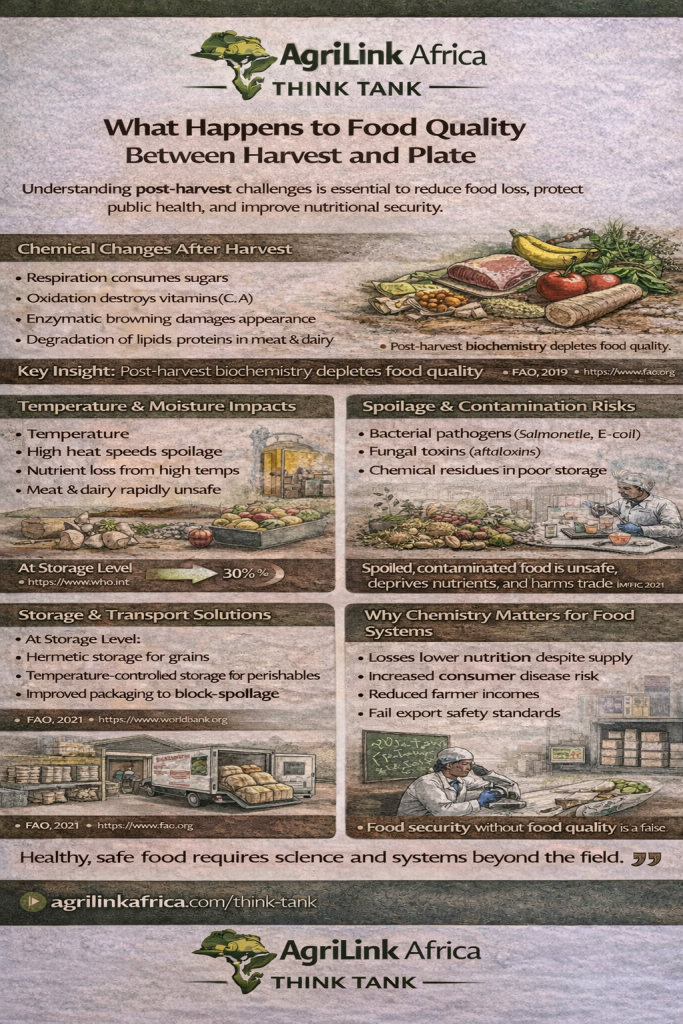
Food quality between harvest and plate is not lost only in the field. Across Africa, a significant share of nutritional value, safety, and market quality is lost after harvest but before consumption. Understanding what happens to food during this critical transition—from harvest to plate—is essential for designing resilient food systems transformation strategies, reducing losses, and protecting public health.
These post-harvest dynamics are central to strengthening African agricultural systems, where production gains are often undermined by downstream quality losses.
This article examines the chemical, biological, and physical processes that degrade food quality post-harvest, and why these invisible changes must be addressed through system-level solutions.
1. Chemical Changes After Harvest
The moment crops are harvested, they begin to change.
Fruits, vegetables, grains, and animal products remain biochemically active after harvest. Respiration, enzymatic reactions, and oxidation continue—often at accelerated rates.
Key chemical processes include:
- Respiration, which consumes sugars and reduces caloric and nutritional content
- Oxidation, leading to vitamin loss (notably vitamin C and A)
- Enzymatic browning, affecting appearance and market value
- Protein and lipid degradation, especially in animal products
According to the Food and Agriculture Organization (FAO), post-harvest biochemical reactions are a major contributor to quality loss in fresh produce across low- and middle-income countries FAO, 2019.
In Africa, where cold storage access is limited, these chemical processes often proceed unchecked.
2. Temperature and Moisture Effects
Temperature and moisture are the two most powerful drivers of post-harvest food quality.
As climate variability intensifies, managing these post-harvest risks becomes even more urgent.
Temperature
- High temperatures increase respiration rates, accelerating spoilage
- Heat degrades heat-sensitive nutrients such as vitamin C, folate, and some antioxidants
- Meat and dairy products become unsafe rapidly without cooling
The World Health Organization highlights temperature abuse as a leading cause of food safety risk in informal and semi-formal food systems WHO, 2020.
Moisture
- Excess moisture promotes mold growth and mycotoxin contamination
- Low moisture in grains reduces spoilage but requires controlled drying
- Poor moisture control damages texture, taste, and shelf life
In Sub-Saharan Africa, post-harvest losses linked to temperature and moisture mismanagement can reach 30–40% for perishables World Bank, 2021.
3. Spoilage and Contamination Risks
Food quality loss is not only about nutrition—it is also about safety.
Spoilage
- Microbial growth causes off-flavors, odors, and texture breakdown
- Spoilage organisms thrive in warm, humid conditions
- Visual spoilage often appears after nutritional degradation has already occurred
Contamination
- Bacterial pathogens (e.g., Salmonella, E. coli)
- Fungal contamination producing aflatoxins
- Chemical contamination from poor storage materials or pesticide residues
The International Food Policy Research Institute (IFPRI) identifies aflatoxin contamination as a major public health and trade barrier in African food systems IFPRI, 2022.
These risks undermine consumer trust, export potential, and long-term health outcomes.
4. Storage and Transport Solutions That Protect Quality
Preserving food quality requires system-level interventions, not isolated technologies.
Effective solutions include:
At Storage Level
- Hermetic storage for grains to reduce moisture and oxygen
- Temperature-controlled storage for perishables
- Improved packaging to limit oxidation and contamination
At Transport Level
- Cold chain logistics for fruits, vegetables, meat, and dairy
- Reduced transport time through better route planning
- Clean, food-grade containers and handling standards
When logistics systems lack resilience, food quality deteriorates rapidly under stress conditions.
Spatial optimization and geospatial planning play a growing role in minimizing quality degradation during transport.
FAO estimates that improving post-harvest handling and storage could reduce food losses by up to 50% in some African value chains FAO, 2021.
Crucially, these solutions must be affordable, scalable, and adapted to local contexts.
5. Why Chemistry Matters for Food Systems
Food systems are often discussed in terms of yields, prices, and access—but chemistry determines outcomes.
Ignoring post-harvest chemical and biological processes leads to:
- Lower nutritional intake despite adequate food supply
- Higher health risks for consumers
- Reduced farmer incomes due to quality downgrades
- Lost export opportunities due to safety standards failures
From a policy perspective, investing in post-harvest science, infrastructure, and standards is as important as investing in production.
As Africa urbanizes and food supply chains lengthen, managing what happens between harvest and plate becomes a central pillar of food security.
Conclusion: Quality Is a System Outcome
Food quality loss is not accidental—it is the predictable result of system gaps.
Protecting food quality in Africa requires:
- Integrating post-harvest chemistry into food policy
- Building cold chain and storage infrastructure
- Training value-chain actors on handling and safety
- Designing markets that reward quality, not just quantity
At AgriLink Africa Think Tank, we argue that food security without food quality is a false victory. The future of African food systems depends on managing not just how food is grown—but how it changes after harvest.
AgriLink Africa Think Tank
System intelligence for Africa’s agricultural future

Abenezer Wondimagegn is the Founder & CEO of AgriLink Africa, a Research & Data Analyst, and Article Publisher. He specializes in Agriculture, Supply Chain, Logistics, Nutrition, E-commerce, and Business Investment. Through his work, he empowers farmers, strengthens food systems, and shares insights to drive innovation and sustainable growth in Ethiopia’s agricultural sector.

