
Executive Insight
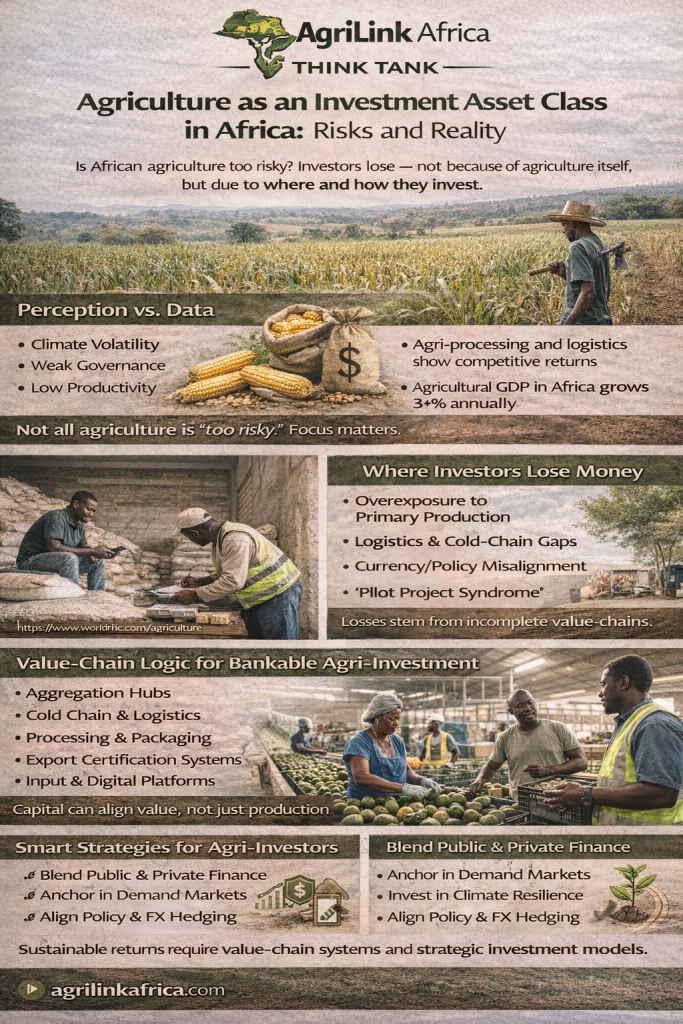
African agriculture is often described as “high risk, low return.” Yet global data tells a more nuanced story: the risk is real, but it is unevenly distributed—and often misunderstood. Losses are not inherent to agriculture itself; they are largely the result of where, how, and at what point in the value chain capital is deployed.
These structural inefficiencies reflect deeper coordination gaps within African agricultural systems, where production, logistics, markets, and policy often operate in isolation rather than as integrated systems
This article reframes agriculture in Africa as an investment asset class, separating myth from evidence, identifying structural risk traps, and outlining strategic models that are already delivering bankable returns.
1. Perception vs. Data: Is African Agriculture Truly Too Risky?
The dominant perception
Investors frequently associate African agriculture with:
- Climate volatility
- Informality and weak governance
- Smallholder fragmentation
- Low productivity
This perception has pushed capital toward extractives and infrastructure, leaving agriculture underfinanced despite employing over 60% of Africa’s workforce.
What the data actually shows
Empirical studies indicate that agri-investment risk is highly segmented:
- Agricultural GDP growth in Sub-Saharan Africa has averaged 3–4% annually, often outperforming population growth World Bank, 2023.
- Agribusiness investments focused on processing, logistics, and input supply show risk-adjusted returns comparable to manufacturing IFC, 2019.
- Volatility is highest at primary production, not across the entire agricultural system.
Key insight: Agriculture is not a single asset class—it is a portfolio of sub-asset classes with different risk-return profiles.
2. Where Investors Actually Lose Money
Losses in African agricultural investment are rarely caused by farming alone. Evidence points to five recurring failure zones:
2.1 Overexposure to primary production
Rain-fed, single-crop farming carries climate and price risks that cannot be diversified without system design.
2.2 Weak aggregation and offtake
Investments fail when produce cannot be:
- Aggregated at scale
- Stored safely
- Sold through guaranteed markets
2.3 Logistics and cold-chain gaps
Up to 30–40% of food value is lost post-harvest in Africa due to transport and storage failures African Development Bank, 2020.
This highlights why cold chain infrastructure remains one of the most underinvested but high-return segments in African agriculture.
2.4 Currency and policy misalignment
Returns in local currency paired with hard-currency debt expose investors to FX risk without adequate hedging mechanisms.
2.5 “Pilot project syndrome”
Short-term donor-style projects masquerading as investments collapse once subsidies end.
Conclusion: Investors lose money not because agriculture is unbankable, but because value-chain architecture is incomplete.
3. Value-Chain Investment Logic: Where Returns Become Bankable
Successful agricultural investments in Africa follow a value-chain-first logic, not a farm-first logic.
As explored in End-to-End Agricultural Value Chains in Africa: Where the Gaps Are, fragmentation across aggregation, logistics, and processing remains the primary barrier to scalable returns.
High-performing investment segments
- Input systems (seed, fertilizer, advisory platforms)
- Aggregation hubs and digital marketplaces
- Cold storage and logistics
- Agro-processing and packaging
- Export certification and traceability systems
According to McKinsey, value-added agribusiness can increase margins by 2–5x compared to raw commodity sales McKinsey, 2021.
Strategic shift: Capital should flow around farmers, not only to farmers.
When downstream systems are weak, agribusiness SMEs often collapse before scaling.
4. Blended Finance: De-risking Agriculture Without Distorting Markets
Blended finance has emerged as a critical bridge between public development goals and private capital.
Effective blended finance structures include:
- First-loss capital from DFIs
- Partial credit guarantees
- Output-based subsidies tied to performance
- Patient equity paired with commercial debt
The Global Impact Investing Network reports that blended structures reduce perceived risk more effectively than direct subsidies GIIN, 2023.
African examples
- Warehouse receipt systems backed by public guarantees
- Climate-smart agriculture funds combining grants and equity
- SME agribusiness funds anchored by development banks
Important principle: Blended finance should crowd in private capital—not replace it.
5. Strategic Investment Principles for African Agriculture System
To treat agriculture as a credible asset class, investors and policymakers must align around five principles:
5.1 Invest in systems, not silos
Returns scale when production, logistics, finance, and markets are integrated.
5.2 Anchor investments in demand
Export markets, institutional buyers, and urban food systems provide predictable cash flows.
5.3 Use technology for coordination, not hype
Digital platforms work best for aggregation, traceability, and logistics—not as standalone apps.
5.4 Price climate risk explicitly
Climate-smart design and insurance must be built into financial models.
Without climate-resilient production systems, agricultural assets become increasingly volatile.
5.5 Align policy with capital
Stable trade policy, land governance, and FX mechanisms are as important as yield.
Yet agricultural policy in many African countries remains poorly aligned with capital deployment strategies.
Closing Perspective: From “Too Risky” to Strategically Investable
African agriculture does not need more charity capital—it needs structured investment intelligence. When viewed through a value-chain lens and supported by blended finance and policy alignment, agriculture becomes:
- Investable
- Scalable
- Impact-positive
The real risk lies not in agriculture itself, but in continuing to treat it as a development problem instead of a strategic economic asset class.
About AgriLink Africa Think Tank
AgriLink Africa Think Tank develops system-level insights at the intersection of agriculture, logistics, technology, and policy to support Africa’s food and economic transformation.
AgriLink Africa Think Tank
Where African Agricultural Intelligence Is Written

Abenezer Wondimagegn is the Founder & CEO of AgriLink Africa, a Research & Data Analyst, and Article Publisher. He specializes in Agriculture, Supply Chain, Logistics, Nutrition, E-commerce, and Business Investment. Through his work, he empowers farmers, strengthens food systems, and shares insights to drive innovation and sustainable growth in Ethiopia’s agricultural sector.

